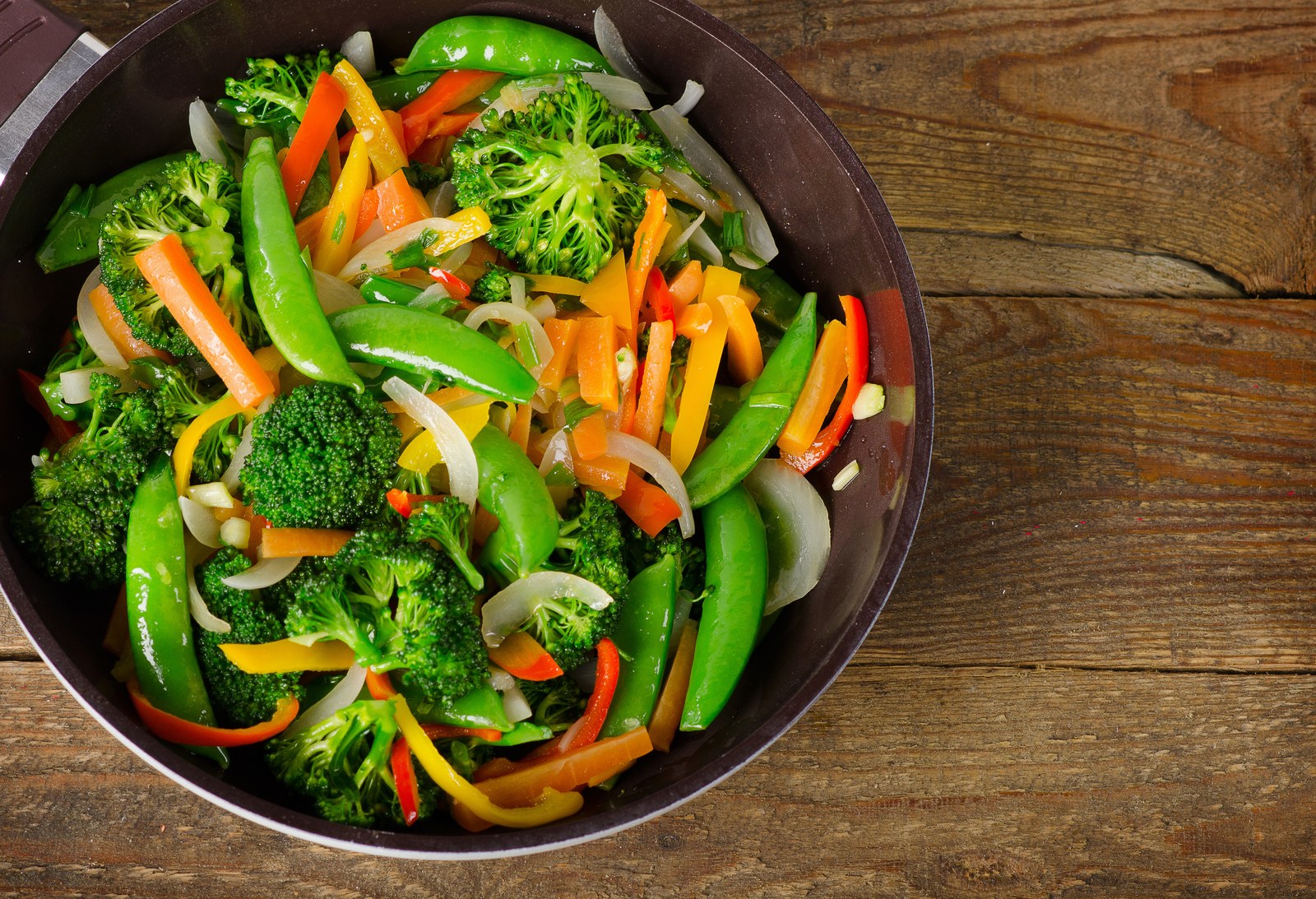
Before you cook
Background Recipe story & origin
Vegetable stir-frying originated in Chinese cooking (dating back centuries, with wok cooking documented as early as the Han Dynasty, 206 BCE-220 CE) where high heat and constant motion in a wok preserved vegetable texture and flavor. The technique spread to America through Chinese immigration during the California Gold Rush (1850s) and peaked in the 1880s-1920s, when Chinese restaurants became widespread in cities like San Francisco and New York. Home wok cooking entered American kitchens through the 1960s-1980s as interest in Asian cuisine grew, aided by cookbook authors like Joyce Chen ('Joyce Chen Cook Book,' 1962) and Martin Yan ('Yan Can Cook,' premiered 1982 on PBS). Soy sauce became widely available in American supermarkets by the 1950s-1960s (Kikkoman introduced soy sauce to American markets in 1957). By the 1980s-1990s, vegetable stir-fry became a weeknight standard in American homes, appearing in cookbooks like 'The Joy of Cooking' (1997 edition). This classic version follows that Chinese-American bridge: accessible vegetables, soy-ginger-garlic sauce, and high-heat technique scaled for home stoves, the quick, healthy, adaptable dish that became an American weeknight staple.
Before you start Equipment you'll need
- wok or large skillet — Retains high heat for proper stir-frying and creates wok hei flavor
- chef's knife — Sharp blade makes precise cuts for even cooking and safer prep work
- cutting board — Stable surface protects counters and keeps prepped ingredients organized
- small bowl — Keeps prepped ingredients organized and ready for quick addition
- heatproof spatula or wooden spoon — Won't scratch cookware and handle stays cool during extended stirring
Safety Safety & allergen notes
- Stir frying uses high heat. Keep handles turned in and move quickly.
- Wet vegetables can cause oil to spit. Pat dry after washing.
- Do not leave the wok unattended. Vegetables scorch fast.
- Keep flammable items away from burner when using high flames.
Non-negotiables Rules for success
-
Cut all vegetables to uniform size for even cooking.
Varied sizes cause some to burn while others stay raw.
-
Have all ingredients prepped before heating wok.
Stir-fry moves fast; no time to prep mid-cooking.
-
Cook vegetables in batches to maintain high heat.
Crowding drops temperature and steams instead of sears.
-
Add vegetables in order of cooking time.
Ensures everything finishes at same time with proper texture.
-
Add sauce at very end, not during cooking.
Early sauce creates soggy, steamed vegetables.
Prep Get set first
About 5 min of prep
- Prepare large skillet or wok
- Have chef's knife ready
- Have cutting board ready
- Have mixing bowl ready
- Have measuring spoons ready
- Have wooden spoon or spatula ready
Vegetable stir fry moves very fast. Have everything prepped and ready before heating the wok.
Ingredients
Instructions
Unlock Grouped Step Actions
Plus members get tap-to-check action steps and live ingredient swaps for this recipe.
-
Make the sauce
In small bowl whisk soy sauce, oyster sauce, rice vinegar, brown sugar, cornstarch, and water until smooth. Set aside.
-
Heat the wok
Place wok over high heat (400-450°F surface) until very hot. Add neutral oil and swirl to coat.
-
Stir-fry the vegetables
Add broccoli, carrots, and onions. Stir fry 3 minutes until they begin to soften.
-
Add the aromatics
Add bell pepper, snap peas, garlic, and ginger. Stir fry 2 to 3 minutes until bright and crisp tender.
-
Add the sauce
Pour sauce into wok. Stir continuously for 1 to 2 minutes until sauce thickens and glazes the vegetables.
-
Finish and serve
Turn off heat. Add sesame oil. Toss once and serve over jasmine rice or noodles.
Chef's notes
Built to pair with jasmine rice, wok fried noodles, scallion fried rice, or as a base for chicken or tofu stir fry.
Slice vegetables on the thinner side for best crisp tender texture.
Cornstarch in the sauce helps with shine and light coating.
For more heat add pinch of chili flakes or teaspoon of chili crisp.