Before you cook
Background Recipe story & origin
Split pea soup may be one of the oldest continuously prepared dishes in human history. Ancient Greeks and Romans were well-documented pea soup enthusiasts — Athenian street vendors sold a thick pea porridge called 'etniton' as far back as the 5th century BC, and the Roman writer Apicius included pea recipes in his famous culinary text 'De Re Coquinaria' around the 1st century AD. The humble split pea, which dries and splits naturally along its seam, was a perfect food for ancient and medieval peoples alike: shelf-stable, nutritious, and cheap enough to feed armies and commoners through long winters and sea voyages.nnAs European trade and colonization spread across the globe, split pea soup traveled with sailors and settlers. The Dutch brought their beloved 'erwtensoep' — a thick, hearty version loaded with pork and vegetables — to the New World in the 17th century, and it became deeply embedded in American colonial cooking. In Canada, particularly Quebec, a similar French-Canadian version called 'soupe aux pois' became a national comfort food, traditionally made with yellow split peas and salt pork. Meanwhile, Scandinavian countries developed their own traditions, with Sweden's 'ärtsoppa' served every Thursday by custom since at least the Middle Ages — a practice said to date back to Catholic fasting rules.nnBy the 19th and 20th centuries, split pea soup had cemented itself as a universal symbol of thrifty, nourishing home cooking across the Western world. The Campbell Soup Company helped popularize a canned version in the early 1900s, bringing the ancient recipe into the modern pantry. Today, every culture that grows peas seems to have its own cherished version — proof that some recipes are simply too good, too practical, and too deeply human to ever go out of style.
Before you start Equipment you'll need
- Large pot (at least 4-quart capacity) — Provides adequate volume for simmering split peas and vegetables without boiling over, allows proper heat distribution for even cooking
- Wooden spoon or stirring spoon — Heat-resistant for stirring soup during long simmering without damaging pot surface or transferring heat to hands
- Knife and cutting board — Essential for preparing vegetables (onions, carrots, celery) into uniform pieces for even cooking
- Measuring cups and spoons — Ensures accurate proportions of split peas, broth, and seasonings for proper soup consistency and flavor balance
- Immersion blender — Creates creamier, smoother texture by partially pureeing cooked peas and vegetables
Safety Safety & allergen notes
- Hot pot and boiling liquid can cause severe burns - use pot holders when handling and keep hands away from steam
- When stirring hot soup, stir away from your body to avoid splashing hot liquid on yourself
- If using an immersion blender, ensure the soup has cooled slightly and blend carefully to avoid hot liquid splattering
- If transferring hot soup to a blender, let it cool for a few minutes first and fill the blender only halfway to prevent overflow
- Remember to remove the bay leaf before serving or blending - it is a choking hazard if swallowed whole
Non-negotiables Rules for success
-
Rinse split peas before adding to pot
Rinsing removes dirt, debris, and excess starch that can make the soup cloudy and gritty
-
Sauté vegetables for 5-7 minutes until softened
This develops flavor through caramelization and ensures vegetables break down properly during the long simmer, creating a well-integrated broth
-
Simmer uncovered on low heat for 50-60 minutes
Low heat prevents scorching on the bottom and allows even cooking; uncovered lets excess moisture evaporate so soup thickens properly instead of becoming watery
-
Remove bay leaf before seasoning and serving
Bay leaves are inedible and can be unpleasant to bite into; they should never be consumed
-
Season only after cooking is complete
Salt added early draws out moisture and can make the soup too salty as it reduces; tasting at the end allows proper seasoning adjustment
Prep Get set first
About 8 min of prep
- Dice onion, carrots, and celery
- Rinse split peas
- Measure broth, water, and dried thyme
- Have large pot ready
- Gather wooden spoon and measuring tools
This is a straightforward soup with about 10 minutes of prep work, then 50-60 minutes of mostly hands-off simmering time.
Ingredients
Instructions
Unlock Grouped Step Actions
Plus members get tap-to-check action steps and live ingredient swaps for this recipe.
-
Heat the olive oil
Heat the olive oil in a large pot over medium heat.
-
Sauté the vegetables
Add the diced onion, carrots, and celery to the pot and sauté for 5-7 minutes until the vegetables begin to soften.
-
Add soup base ingredients
Add the rinsed split peas, broth, water, bay leaf, and thyme to the pot and stir well.
-
Simmer the soup
Bring the mixture to a boil, then reduce the heat to low and simmer uncovered for 50-60 minutes, stirring occasionally.
-
Check doneness
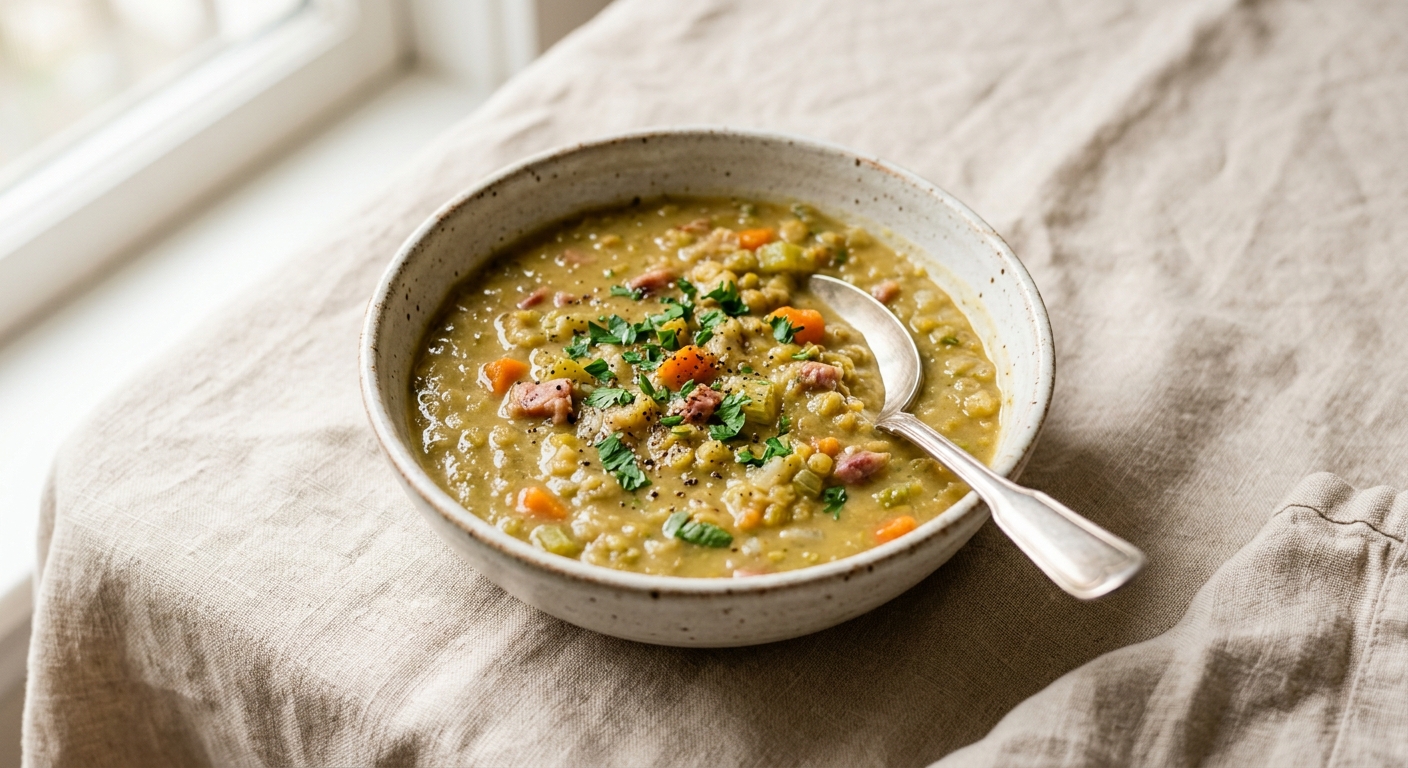
The soup is ready when the split peas have broken down and the soup has thickened; some peas should be completely dissolved while others remain slightly chunky.
-
Season the soup
Remove the bay leaf and season the soup with salt and black pepper to taste.
-
Optional: Blend for creamier texture
For a creamier texture, use an immersion blender to partially blend the soup, or transfer half the soup to a blender and puree before returning it to the pot.
Chef's notes
This soup thickens as it cools; reheat gently and add broth or water if needed.
Serve with crusty bread, crackers, or a grilled cheese sandwich for a complete meal.
Can be made up to 2 days ahead; flavors deepen overnight. Store covered in refrigerator.
Tomorrow's Meal
Crispy Split Pea Soup Cakes
Thick, cooled split pea soup bound with breadcrumbs and pan-fried until golden and crispy outside, creamy inside
You'll need to pick up:
Quick overview:
- Cool leftover soup completely in refrigerator
- Mix 2 cups soup with 1/3 cup breadcrumbs until thick and moldable
- Form into 3-inch patties, coat lightly with additional breadcrumbs
- Heat 1/4 inch oil in skillet to 350°F
- Fry patties 3-4 minutes per side until golden brown and crispy
- Drain on paper towels, serve hot with sour cream and fresh herbs