Before you cook
Background Recipe story & origin
The story of pan-seared salmon with beurre blanc is really two stories woven together. Salmon has been prized across Northern European and Atlantic cultures for millennia—smoked, cured, and cooked over open fires by Celtic, Norse, and Indigenous peoples long before the French ever thought to pair it with butter. But it was in the restaurant kitchens of Paris and Lyon during the 19th century that pan-searing emerged as the preferred technique for achieving that coveted golden crust while keeping the flesh tender and moist inside. The high heat of a heavy iron or steel pan became the chef's tool of choice for transforming fresh Atlantic salmon into something transcendent.nnThe beurre blanc sauce has a more precise and charming origin. According to culinary legend, it was created around 1890–1900 by a cook named Clémence Lefeuvre—or possibly her assistant, Mère Michel—in the Loire Valley town of Saint-Julien-de-Concelles, near Nantes. The story goes that she was attempting to make a béarnaise sauce for a local nobleman but forgot to add the eggs, accidentally producing instead a pure emulsified butter sauce built on a reduction of white wine and shallots. Rather than admit the mistake, she served it confidently, and her guests were enchanted. The sauce became her signature, and word spread through the region's culinary circles.nnBy the mid-20th century, beurre blanc had been codified and elevated by the great French chefs, appearing in the works of Auguste Escoffier's successors and later championed by nouvelle cuisine pioneers like Michel Guérard and Paul Bocuse, who appreciated its lightness compared to heavier cream-based sauces. The pairing with salmon was a natural marriage—the richness of the butter sauce complementing the fatty, flavorful fish—and it became a signature of French-influenced fine dining worldwide. Today, pan-seared salmon with lemon beurre blanc sits at the intersection of rustic Loire Valley tradition and modern restaurant elegance, a dish that feels simultaneously timeless and effortlessly sophisticated.
Safety Safety & allergen notes
- Hot skillet and oil can cause severe burns - use pot holders when handling the pan and keep hands away from steam
- Wine reduction boils vigorously - stand back from saucepan to avoid splashing hot liquid
- Beurre blanc sauce must stay below boiling point or it will break - keep heat on low when whisking in butter
- Hot spatula and utensils retain heat after cooking - place on heat-safe surface and use pot holders
- Salmon internal temperature should reach 145°F for food safety - use a meat thermometer to verify doneness
Non-negotiables Rules for success
-
Pat salmon fillets completely dry before seasoning
Moisture on the surface prevents proper browning and creates steam that inhibits crispy skin formation during searing
-
Bring salmon to room temperature 15 minutes before cooking
Cold fish cooks unevenly with overcooked exterior and undercooked center; room temperature ensures even, gentle cooking through
-
Reduce wine mixture to 2-3 tablespoons before adding cream
Insufficient reduction leaves excess liquid that dilutes the sauce and prevents proper emulsification with butter
-
Whisk butter in one piece at a time on low heat, never allowing the sauce to boil
High heat or rapid butter addition breaks the emulsion by separating fat from liquid, causing a greasy, broken sauce
-
Do not move salmon for 4-5 minutes after placing skin-side down
Moving disrupts crust formation and causes the delicate skin to stick and tear, preventing the deeply golden, crispy texture
-
Cook salmon to medium doneness with slightly translucent center
Fully cooked salmon becomes dry and loses its tender, buttery texture; slight translucency indicates optimal moisture retention
Prep Get set first
About 8 min of prep
- Remove salmon from refrigerator to bring to room temperature
- Pat salmon fillets dry with paper towels
- Mince shallots and chop fresh chives
- Zest lemon and juice it
- Cut cold butter into tablespoon-sized pieces
- Gather all ingredients for beurre blanc (wine, vinegar, cream, cayenne)
- Set up small saucepan and whisk
- Set up large skillet and fish spatula
- Prepare small bowl and water bath setup for sauce
This elegant dish requires about 30 minutes total with careful attention to sauce emulsification and precise salmon cooking timing.
Ingredients
Instructions
Unlock Grouped Step Actions
Plus members get tap-to-check action steps and live ingredient swaps for this recipe.
-
Prep the salmon
Remove salmon from refrigerator 15 minutes before cooking to bring to room temperature. Pat fillets completely dry with paper towels and season both sides generously with salt and pepper.
-
Reduce the wine and shallots
Combine white wine, white wine vinegar, and minced shallots in a small saucepan over medium-high heat. Bring to a boil and reduce until only 2–3 tablespoons of liquid remain, about 5–7 minutes.
-
Add cream and reduce heat
Add heavy cream to the reduction and simmer for 1 minute. Reduce heat to low.
-
Whisk in the butter
Begin whisking in the cold butter pieces one at a time, waiting until each piece is almost fully incorporated before adding the next. The sauce should become smooth, creamy, and slightly thickened. Do not let the sauce boil or it will break.
-
Finish and hold the beurre blanc
Remove from heat and whisk in lemon juice, lemon zest, and cayenne pepper. Strain through a fine-mesh sieve into a small bowl. Cover and keep warm in a warm water bath.
-
Heat the pan
Heat olive oil in a large stainless steel or cast iron skillet over medium-high heat until shimmering but not smoking.
-
Sear the salmon skin-side down
Place salmon fillets skin-side down in the pan. Press gently with a spatula for 10 seconds to prevent curling. Cook without moving for 4–5 minutes until skin is deeply golden and crispy.
-
Flip and finish cooking
Carefully flip salmon and cook for an additional 2–4 minutes depending on thickness, until just cooked through but still slightly translucent in the center for medium doneness.
-
Plate and sauce
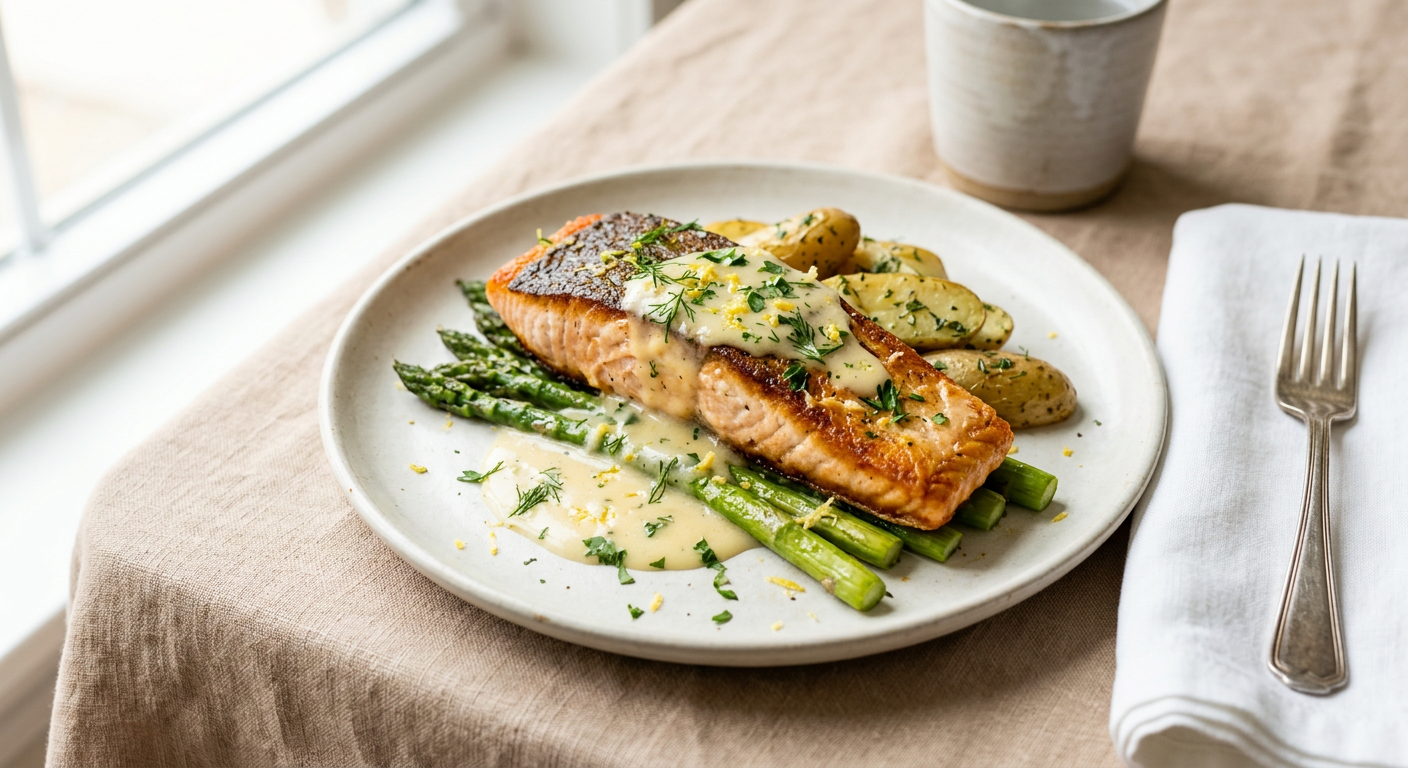
Transfer salmon to serving plates skin-side up. Whisk the beurre blanc sauce briefly to re-emulsify if needed, then spoon generously over the salmon.
-
Garnish and serve
Garnish with fresh chives and serve immediately.
Chef's notes
Beurre blanc is best served immediately and does not reheat well, so prepare it while the salmon cooks.
For a lighter sauce, you can use half the amount of butter for a thinner but still flavorful result.
Substitute halibut, sea bass, or arctic char for the salmon if desired.
Serve with steamed asparagus, roasted fingerling potatoes, or a simple green salad.