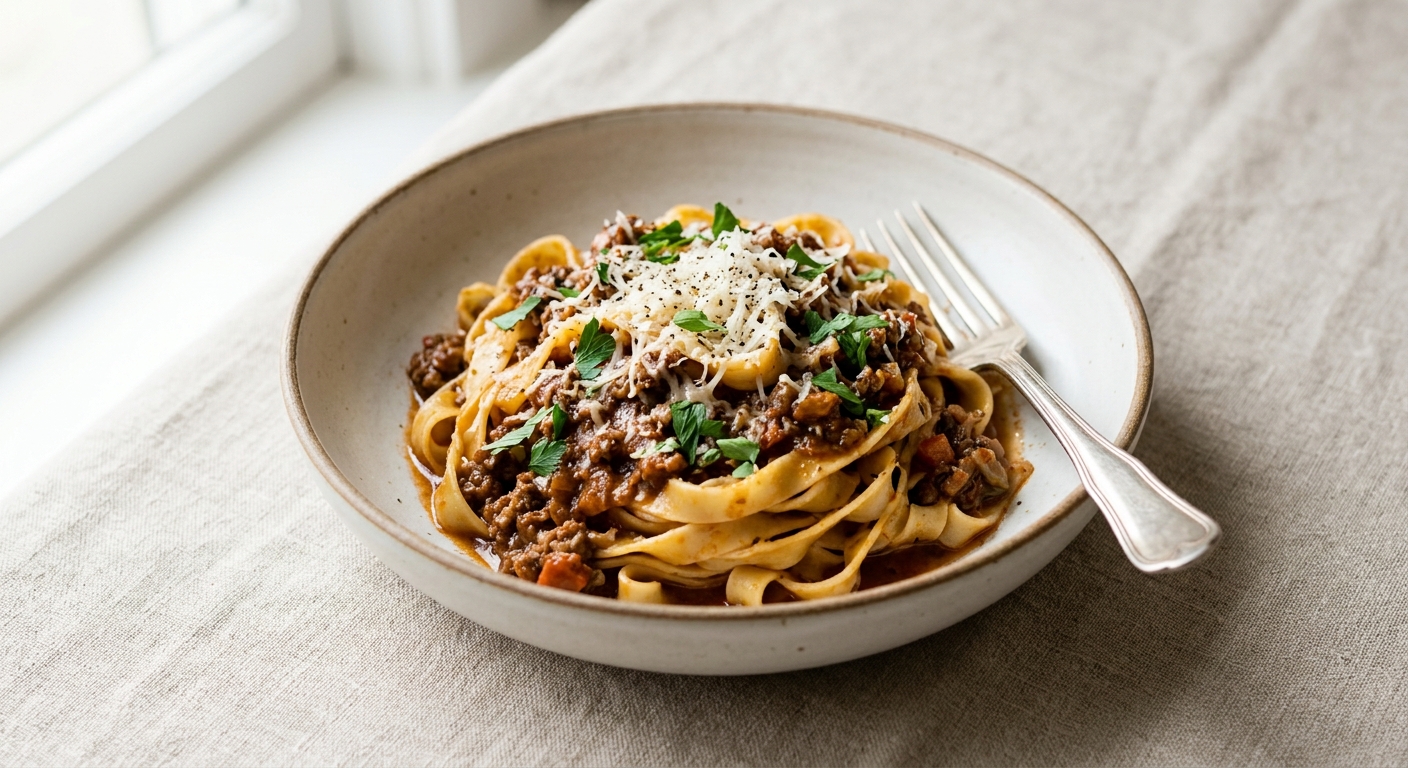
Before you cook
Background Recipe story & origin
The story of Fettuccine Bolognese is deeply rooted in the culinary traditions of Bologna, the capital of the Emilia-Romagna region in northern Italy. The ragù Bolognese—the rich, slow-cooked meat sauce that defines this dish—emerged during the Renaissance when Bologna was a prosperous city-state. Local cooks began combining ground meat with tomatoes (introduced from the Americas in the 16th century), wine, and aromatics, creating a sauce that reflected the region's abundance of pork and dairy. By the 18th century, ragù Bolognese had become the signature sauce of Bologna's elite cuisine, appearing in cookbooks and aristocratic kitchens throughout Italy.nnInterestingly, traditional Bolognese cooking actually pairs ragù with fresh egg pasta sheets called tagliatelle, not fettuccine. Fettuccine, the wider ribbon pasta, is more commonly associated with Roman cuisine. The modern pairing of fettuccine with Bolognese sauce became popular internationally during the 20th century, particularly in America, where Italian immigrants adapted traditional recipes using available ingredients. This version spread globally through restaurants and cookbooks, eventually becoming the most recognized form of the dish outside Italy.nnThe authentic ragù Bolognese remains a point of pride in Bologna—in 1982, the Bologna Chamber of Commerce officially registered a traditional recipe, emphasizing the slow cooking process (at least three hours) and the balance of meat, tomato, and cream. While fettuccine Bolognese may not be the traditional pairing, it has become a beloved classic that introduced millions to the depths of Italian cooking, even as purists in Bologna insist on tagliatelle as the proper vessel for their treasured ragù.
Before you start Equipment you'll need
- Large heavy-bottomed pot or Dutch oven — Distributes heat evenly for slow simmering without scorching the delicate sauce
- Large pasta pot — Boils pasta to proper texture; needs volume for rolling boil
- Wooden spoon or silicone spatula — Breaks up meat and stirs sauce without damaging the pot surface
- Colander — Drains pasta without losing noodles
- Measuring cups and spoons — Ensures consistent ingredient ratios
Safety Safety & allergen notes
- Ground beef must reach 160°F internal temperature to be safe - use a meat thermometer to verify no pink remains
- Hot pot and pan surfaces reach 325-375°F - use pot holders or oven mitts when handling; keep hands and arms away from steam
- When deglazing with wine, add slowly to avoid splattering hot liquid - keep face and body back from pot
- Boiling pasta water can cause severe burns - stir pasta away from your body and keep children away from the pot
- Steam from simmering sauce can burn - lift pot lid away from you, never directly overhead
Non-negotiables Rules for success
-
Break apart ground beef with a wooden spoon while cooking until no pink remains
Breaking the meat into small pieces increases surface area for even browning and ensures all meat cooks to safe temperature; leaving it in chunks results in undercooked centers and uneven texture
-
Scrape up browned bits (fond) from pot bottom when deglazing with wine
The fond contains concentrated flavors from meat browning; scraping it up dissolves these flavorful compounds into the sauce, creating depth; leaving it behind loses significant umami and richness
-
Let wine reduce by half before adding tomatoes
Reducing concentrates wine flavor and burns off harsh alcohol; adding tomatoes too early dilutes the wine and prevents proper flavor development and alcohol evaporation
-
Simmer sauce uncovered on low heat for 60-75 minutes, stirring occasionally
Low heat prevents scorching and allows flavors to meld gradually; uncovered pan lets moisture evaporate to thicken sauce; high heat or covered pot creates thin, one-dimensional sauce with burnt taste
-
Cook pasta until al dente, not soft
Al dente pasta has firm bite and won't turn mushy when mixed with hot sauce; overcooked pasta absorbs too much liquid and becomes gluey when tossed with Bolognese
Prep Get set first
About 10 min of prep
- Dice 1 medium onion and 1 medium carrot
- Mince 3 cloves garlic
- Measure out 2 tablespoons olive oil
- Have 1 pound ground beef ready
- Measure 0.5 cup dry red wine
- Measure 3 tablespoons tomato paste
- Open 1 can (28 oz) crushed tomatoes
- Measure 0.5 cup beef broth
- Measure 0.25 cup whole milk
- Have salt and black pepper accessible
- Measure 1 pound fettuccine
- Fill large pot with 4 quarts water
- Gather large heavy-bottomed pot, large pasta pot, wooden spoon, and colander
This is a 90+ minute recipe with mostly hands-off simmering time; active prep and cooking takes about 35 minutes total.
Ingredients
Instructions
Unlock Grouped Step Actions
Plus members get tap-to-check action steps and live ingredient swaps for this recipe.
0/14 actions complete
Start checking off actions as you prep
-
Sauté aromatics and brown the meat
-
Deglaze and add tomato base
-
Simmer the sauce
-
Cook the pasta
Colander
-
Plate and serve
Chef's notes
Bolognese improves when made a day ahead; refrigerate and reheat gently before serving.
Do not rush the simmer—low heat for 60–90 minutes develops depth that quick cooking cannot achieve.
Stir occasionally to prevent sticking and ensure even cooking of the meat.
Whole milk or heavy cream mellows acidity; omit if you prefer a sharper tomato flavor.
Freshly grated Parmigiano-Reggiano added at the table brightens the dish.
For a leaner sauce, use 85/15 ground beef or substitute half with ground pork.