Before you cook
Background Recipe story & origin
The story of cheesecake stretches back nearly 3,000 years to ancient Greece, making it one of the oldest known desserts in Western culinary history. Greek physician Aegimus is credited with writing the first known treatise on the art of making cheesecake, and the simple mixture of fresh cheese, wheat, and honey was considered nourishing enough to fuel Olympic athletes. When the Romans conquered Greece, they adopted the recipe and spread variations of it across Europe, from Britain to Eastern Europe, each region adapting it with local cheeses and flavors.nnThe cheesecake as we know it today took a dramatic turn in the late 19th century when a New York dairyman named William Lawrence accidentally created cream cheese in 1872 while trying to replicate a French cheese called Neufchâtel. This rich, dense cheese became the foundation for what would evolve into the iconic New York-style cheesecake. Jewish immigrants in New York's Lower East Side embraced cream cheese enthusiastically, incorporating it into their baking traditions and helping popularize the dense, creamy style that became a city signature.nnBy the early 20th century, New York restaurateurs like Arnold Reuben were claiming credit for perfecting the cream cheese cheesecake recipe, and the dessert became synonymous with the city's deli culture. Meanwhile, regional styles flourished across America and Europe—Chicago's sour cream-topped version, Italy's ricotta-based torta di ricotta, and Japan's impossibly light soufflé cheesecake all emerged as beloved local interpretations. Today, classic cheesecake stands as one of the most universally beloved desserts in the world, its ancient origins transformed into countless modern variations.
Before you start Equipment you'll need
- 9-inch springform pan — Allows easy removal of cheesecake without damaging delicate cake structure; removable sides prevent breakage
- Larger roasting pan (for water bath) — Creates steam environment for even, crack-free baking and creamy texture throughout
- Electric mixer or mixing bowl with whisk — Thoroughly incorporates cream cheese and eggs for smooth, lump-free batter
- Measuring cups and spoons — Ensures precise ingredient ratios critical for proper cheesecake consistency and baking
- Small bowl — Convenient for combining dry ingredients or preparing crust mixture separately
- Large bowl — Provides ample space for mixing cheesecake filling without splattering
- Spatula — Scrapes bowl sides to ensure even mixing and helps transfer batter to pan
- Oven thermometer — Verifies accurate oven temperature to prevent overbaking and cracking
Safety Safety & allergen notes
- Oven racks and pans are extremely hot during and after baking - use oven mitts or pot holders when handling the springform pan, roasting pan, and oven racks
- Hot water in the water bath can cause severe burns - pour carefully and keep hands away from steam when adding hot water to the roasting pan
- When cracking the oven door open in step 12, keep face and hands clear to avoid steam burns from the hot oven interior
- The cheesecake and all equipment remain dangerously hot for extended periods - allow adequate cooling time and always use protective gear when handling
Non-negotiables Rules for success
-
Use room-temperature cream cheese and beat until completely smooth before adding other ingredients
Cold cream cheese creates lumps that won't fully incorporate, resulting in grainy texture throughout the finished cheesecake
-
Add eggs one at a time on low speed and mix only until just incorporated; do not overmix
Overmixing incorporates excess air which causes the cheesecake to rise too much during baking and then crack and sink as it cools
-
Use a water bath and bake at 325°F until the center jiggles slightly (about 2-inch wobble)
Water bath provides gentle, even heat that prevents the edges from overbaking and cracking; underbaking slightly allows carryover cooking during cooling and prevents a dense, dry texture
-
Cool gradually by turning off oven and cracking door open for 1 hour, then cool to room temperature before refrigerating
Rapid temperature changes cause thermal shock and cracks; gradual cooling allows the structure to set gently and prevents the dreaded cheesecake crack
-
Refrigerate for at least 4 hours, preferably overnight, before serving
Chilling allows the cheesecake to fully set and the flavors to develop and meld; serving too soon results in a soft, unstable texture
Prep Get set first
About 8 min of prep
- Preheat oven to 325°F (160°C)
- Gather all ingredients and bring cream cheese, eggs, and sour cream to room temperature
- Prepare 9-inch springform pan
- Have larger roasting pan ready for water bath
- Measure out graham cracker crumbs, butter, and sugars
- Get electric mixer, large bowl, small bowl, and spatula ready
- Fill kettle with water for water bath
This cheesecake requires 2+ hours total (15 min prep, 50 min bake, 1.5 hours cooling, plus 4+ hours chilling), so plan ahead.
Ingredients
Instructions
Unlock Grouped Step Actions
Plus members get tap-to-check action steps and live ingredient swaps for this recipe.
-
Preheat oven and prepare pan
Preheat your oven to 325°F (160°C) and position the rack in the center.
-
Make graham cracker crust
Mix graham cracker crumbs, melted butter, and granulated sugar in a small bowl until the texture resembles wet sand.
-
Press crust into pan
Press the mixture firmly into the bottom of a 9-inch springform pan, creating an even layer.
-
Bake crust until golden
Bake the crust until lightly golden. Remove from oven and let cool slightly.
-
Beat cream cheese until smooth
In a large bowl, beat the room-temperature cream cheese with an electric mixer on medium speed until smooth and creamy, scraping down the bowl as needed.
-
Add sugar and flour to cream cheese
Add granulated sugar and all-purpose flour to the cream cheese and beat on low speed until just combined.
-
Add eggs one at a time
Add eggs one at a time, beating on low speed after each addition just until incorporated. Do not overmix.
-
Fold in sour cream and vanilla
Gently fold in the sour cream, vanilla extract, and salt using a spatula until just combined.
-
Pour filling into crust
Pour the filling over the cooled crust and smooth the top with a spatula.
-
Prepare water bath
Place the springform pan inside a larger roasting pan. Add hot water to the roasting pan until it reaches halfway up the sides of the springform pan.
-
Bake cheesecake until set
Bake until the cheesecake is set but the center still jiggles slightly when gently shaken (about a 2-inch diameter circle in the center should wobble).
-
Cool cheesecake in oven
Turn off the oven and crack the door open about 4 inches. Leave the cheesecake in the oven to cool gradually.
-
Cool to room temperature
Remove the cheesecake from the oven and water bath. Let it cool to room temperature on a wire rack.
-
Refrigerate before serving
Refrigerate the cheesecake for at least 4 hours, preferably overnight, before serving.
Chef's notes
Store the cheesecake covered in the refrigerator for up to 5 days before serving.
For best flavor and texture, serve chilled or at room temperature.
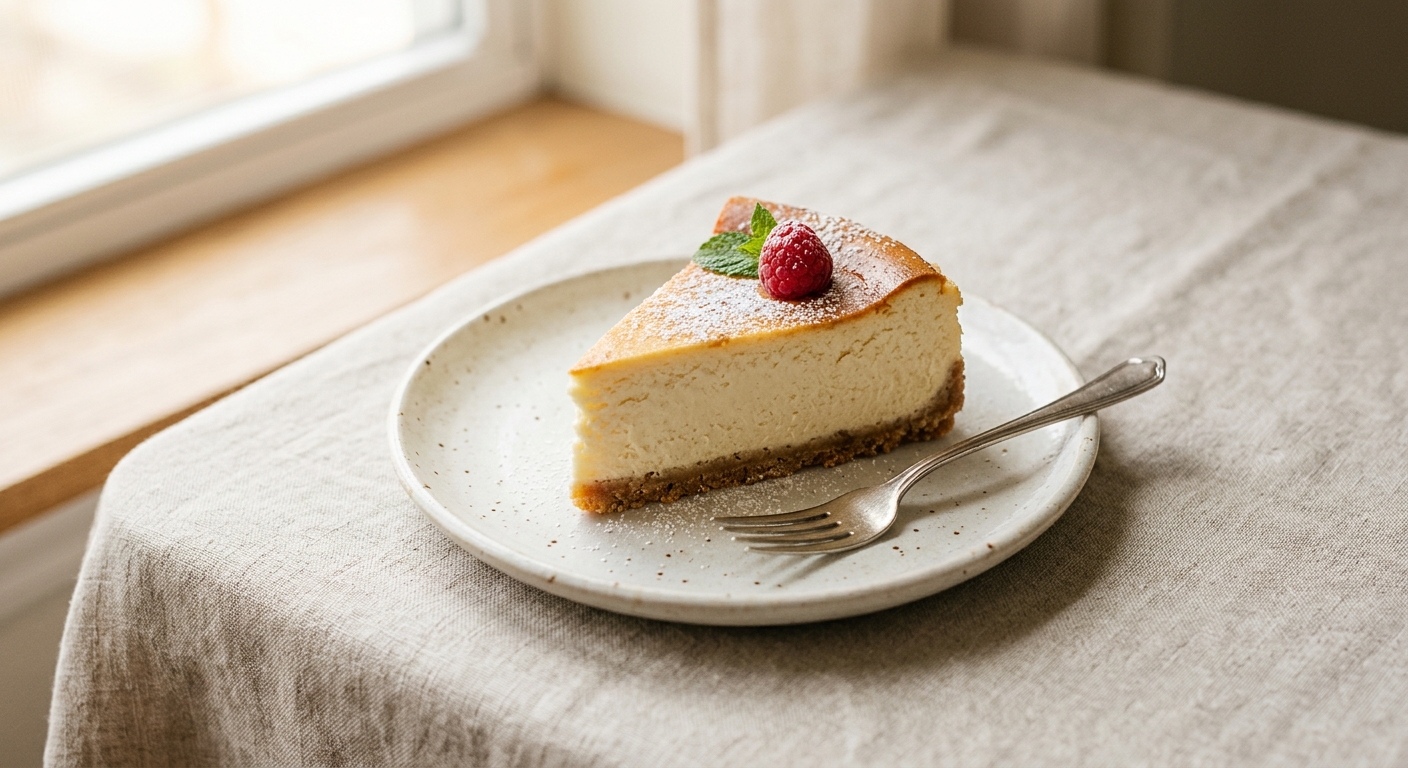
Top with fresh berries, fruit compote, chocolate ganache, or caramel sauce before serving.
A thin-bladed knife dipped in hot water and wiped clean between cuts will help achieve clean slices.
Tomorrow's Meal
Cheesecake Bread Pudding
Slice leftover cheesecake into cubes, layer with custard mixture and bake until golden for an elegant bread pudding dessert
You'll need to pick up:
Quick overview:
- Cut cold cheesecake into 1-inch cubes
- Whisk together 4 eggs, 1 cup cream, 1 cup milk, 2 tsp vanilla, 2 tbsp sugar
- Butter a 9x13 baking dish and layer cheesecake cubes
- Pour custard mixture over cubes, let soak 15 minutes
- Bake at 350°F for 35-40 minutes until set but slightly jiggly in center
- Cool 10 minutes before serving warm