Before you cook
Background Recipe story & origin
The fajita story begins deep in the ranchlands of the Rio Grande Valley, where Mexican cowboys known as vaqueros working Texas cattle drives in the 1930s were paid partly in meat—specifically the scraps and lesser cuts that Anglo ranchers didn't want, including the diaphragm muscle known as skirt steak. These resourceful workers marinated the tough meat, grilled it over open fires, and wrapped it in flour tortillas, creating a dish that was born from necessity and perfected by ingenuity. The word 'fajita' itself comes from the Spanish 'faja,' meaning belt or strip, a reference to the long, narrow cut of meat.nnFor decades, fajitas remained a regional specialty known mainly to border communities and South Texas ranching families. That changed in 1969 when Sonny Falcon, a meat market manager from Kyle, Texas, began selling grilled skirt steak at outdoor festivals and fairs, earning him the unofficial title of 'The Fajita King.' The dish gained wider attention when Austin restaurateur Ninfa Rodrigues Laurenzo put fajitas—which she called 'tacos al carbon'—on the menu of her Houston restaurant Ninfa's in 1973, introducing the sizzling platter presentation to a broader American audience.nnChicken fajitas emerged as restaurants in the 1980s sought to capitalize on the fajita craze while offering a lighter, more affordable alternative to beef. When chef George Weidmann introduced fajitas at the Hyatt Regency in Austin in 1982, the dish went mainstream almost overnight, and chicken quickly followed as a popular variation. The iconic sizzling cast-iron skillet, the trio of peppers and onions, the sides of guacamole and sour cream—these became the hallmarks of a dish that defined Tex-Mex cuisine for a generation and remains one of the most beloved staples of American casual dining today.
Safety Safety & allergen notes
- Cast-iron skillet reaches very high temperatures - use tongs to handle food and pot holders for the pan handle to prevent severe burns
- Keep hands and face away from the skillet when it's preheating and cooking, as oil may splatter
- When searing chicken, do not crowd the pan - work in batches if needed to avoid steam burns from overcrowding
- Use an instant-read thermometer to verify chicken reaches 165°F (74°C) internal temperature to prevent foodborne illness
- When warming tortillas over a gas burner, keep fingers clear of the flame and use tongs to flip - risk of hand burns from direct flame contact
Non-negotiables Rules for success
-
Slice chicken against the grain into uniform 0.5-inch strips
Slicing against the grain breaks up muscle fibers, making the chicken tender and easier to chew; uniform thickness ensures even cooking without dry or undercooked pieces
-
Heat skillet until it just begins to smoke before adding chicken
Extremely high heat creates a golden-brown crust through the Maillard reaction, developing flavor and the signature sizzle; insufficient heat causes steaming instead of searing
-
Don't crowd the pan when searing chicken; cook in single layer undisturbed for 3-4 minutes
Overcrowding drops pan temperature and traps steam, preventing browning; undisturbed cooking allows proper crust formation before flipping
-
Use two-thirds of spice blend on chicken and one-third on vegetables
Distributing the blend prevents over-seasoning any single component and ensures balanced flavor throughout the dish
-
Cook peppers and onions without stirring for first 2-3 minutes
Undisturbed cooking creates charred, caramelized surfaces that develop deep flavor; constant stirring prevents browning and results in steamed vegetables
Prep Get set first
About 8 min of prep
- Slice chicken breasts against the grain into 0.5-inch strips
- Core, seed, and slice 3 bell peppers into 0.25-inch strips
- Peel and slice 1 large onion into 0.25-inch half-moon strips
- Mince 3 garlic cloves
- Slice 1 avocado and cut lime into wedges
- Measure out all spices (chili powder, cumin, paprika, garlic powder, onion powder, oregano, cayenne, salt, pepper)
- Have cast-iron skillet, large mixing bowl, small mixing bowl, sharp knife, cutting board, tongs, and meat thermometer ready
- Set out tortillas, sour cream, cheese, cilantro for assembly
This recipe requires active cooking time of about 25-30 minutes total with proper prep, so have everything cut and measured before you start cooking at high heat.
Ingredients
Instructions
Unlock Grouped Step Actions
Plus members get tap-to-check action steps and live ingredient swaps for this recipe.
-
Make the fajita spice blend
In a small bowl, combine the chili powder, cumin, smoked paprika, garlic powder, onion powder, dried oregano, cayenne pepper, salt, and black pepper. Stir until evenly mixed.
-
Slice the chicken
Slice the chicken breasts against the grain into strips about 0.5 inch thick. Place the strips in a large bowl.
-
Marinate the chicken
Add 1.5 tablespoons of olive oil, the lime juice, and the minced garlic to the chicken. Sprinkle in two-thirds of the spice blend and toss until evenly coated. Set aside to marinate at room temperature for at least 10 minutes.
-
Prep and season the vegetables
Core and seed the bell peppers, then slice into 0.25-inch strips. Peel the onion, halve through the root, and slice into 0.25-inch half-moon strips. Toss the peppers and onion with the remaining 1.5 tablespoons of olive oil and the rest of the spice blend.
-
Heat the skillet
Heat a large cast-iron skillet or heavy-bottomed pan over high heat until very hot and just beginning to smoke.
-
Cook the peppers and onions
Add the seasoned peppers and onions to the hot skillet in a single layer. Cook without stirring for 2 to 3 minutes to char slightly, then stir and cook for another 2 to 3 minutes until softened and lightly blistered. Transfer to a plate and keep warm.
-
Sear the chicken
Return the skillet to high heat. Add the marinated chicken strips in a single layer without crowding. Cook undisturbed for 3 to 4 minutes until a golden-brown sear develops, then flip and cook for another 2 to 3 minutes until cooked through to 165°F (74°C).
-
Combine and finish
Return the cooked peppers and onions to the skillet with the chicken. Toss everything together and cook for 1 minute to meld the flavors. Squeeze the juice of half a lime over the top.
-
Warm the tortillas
Warm the flour tortillas by placing them directly over a gas burner for 15 to 20 seconds per side until lightly charred, or wrap in a damp paper towel and microwave for 30 to 45 seconds.
-
Prep garnishes and serve
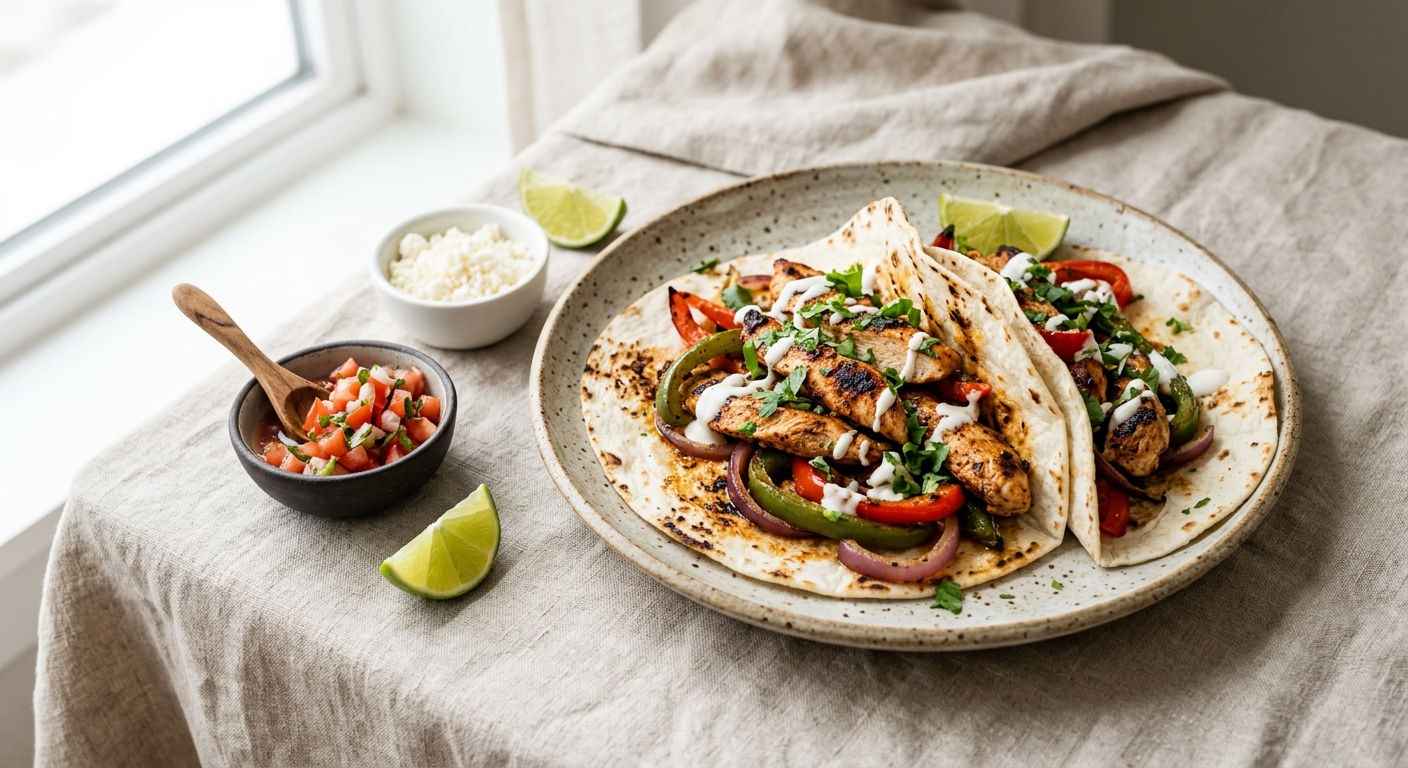
Slice the avocado and cut the remaining lime into wedges. Serve the chicken and vegetable mixture from the skillet alongside the warm tortillas, sour cream, shredded cheese, avocado slices, fresh cilantro, and lime wedges so everyone can build their own fajitas.
Chef's notes
The fajita spice blend can be made in bulk and stored in an airtight jar for up to 3 months, making future batches even quicker to prepare.
Serve with additional toppings such as pico de gallo, jalapeño slices, hot sauce, or refried beans to round out the meal.
For a lower-carb option, serve the chicken and vegetable mixture over a bed of rice or in lettuce cups instead of tortillas.
To make this dish gluten-free, substitute corn tortillas for flour tortillas and verify that your spices are certified gluten-free.
Tomorrow's Meal
Crispy Chicken Fajita Quesadillas
Shredded leftover chicken and peppers crisped in a skillet-toasted tortilla with melted cheese and a fried egg
You'll need to pick up:
Quick overview:
- Shred any leftover cooked chicken; chop peppers and onions into bite-sized pieces
- Heat skillet over medium-high heat with 1 tablespoon butter
- Place tortilla in skillet, add cheese, chicken, peppers, and more cheese on one half
- Fold tortilla in half, cook 2-3 minutes until golden, flip and cook another 2 minutes until crispy
- Transfer to plate, top with fried egg if desired, serve with sour cream and salsa