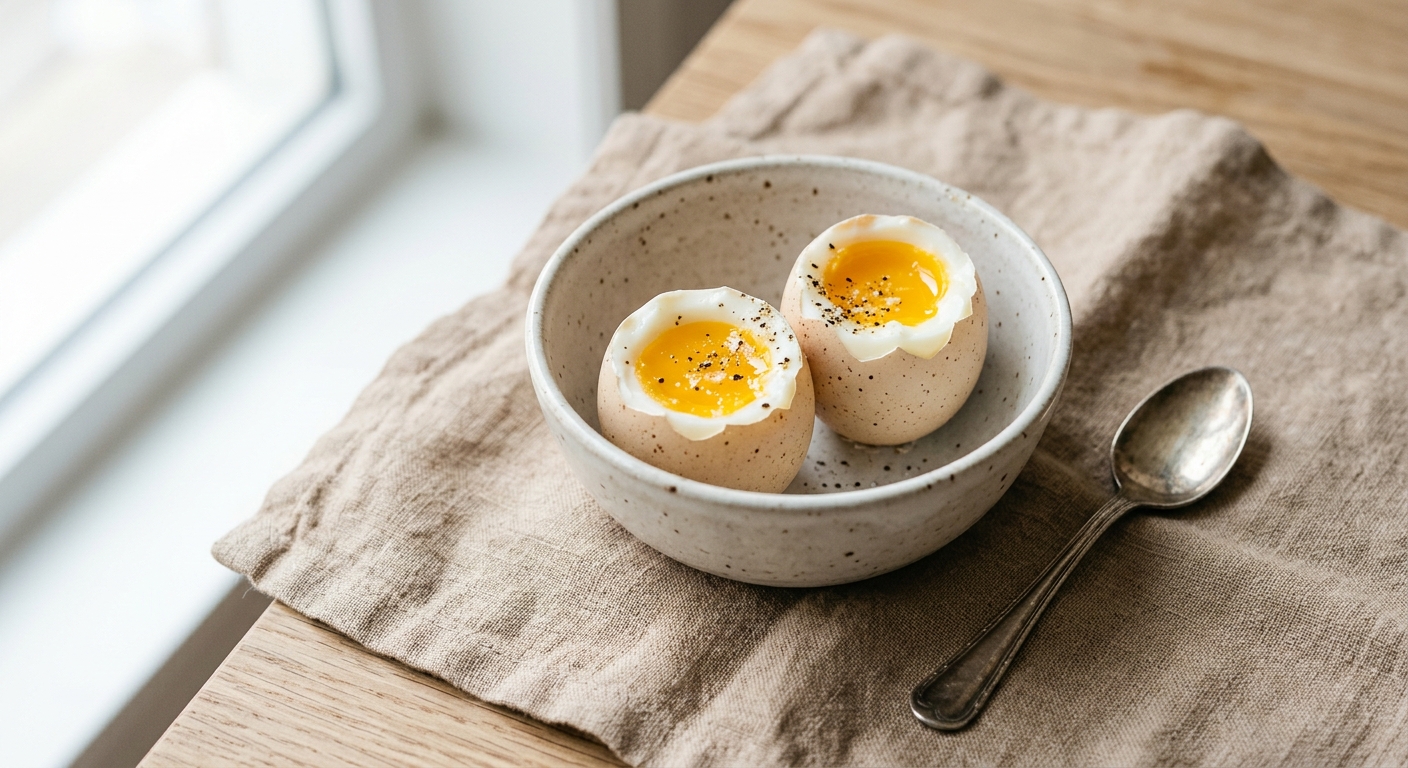
Before you cook
Background Recipe story & origin
The story of the soft-boiled egg is, in many ways, the story of civilization itself. Chickens were first domesticated in Southeast Asia around 6000 BCE, and humans have been boiling their eggs ever since. Ancient Romans were particularly fond of eggs as a first course — the Latin phrase 'ab ovo usque ad mala' (from egg to apple) described a full meal from start to finish — and boiling was the most practical cooking method available. Early boiled eggs were likely cooked through entirely, as the subtlety of timing a runny yolk required a level of culinary precision that came later.nnThe art of the perfectly soft-boiled egg, with its set white and flowing golden yolk, was elevated in the great kitchens of 19th-century Europe. The French, with their obsessive attention to technique, codified the soft-boiled egg — known as 'oeuf à la coque' — as a mark of culinary refinement. Served in elegant egg cups, often at aristocratic breakfast tables, it became a symbol of civilized morning ritual. The English embraced it with equal enthusiasm, and the egg cup itself became a fixture of Victorian tableware, with elaborate silver designs crafted specifically for the occasion of eating a soft-boiled egg.nnOver time, the soft-boiled egg transcended class boundaries and spread across global cuisines in remarkably diverse forms. In Japan, the 'ajitsuke tamago' — a soy-marinated soft-boiled egg with a custard-like yolk — became an essential topping for ramen. In Germany, soft-boiled eggs remain a beloved breakfast staple eaten straight from the shell. Today, the soft-boiled egg enjoys a renaissance in modern cuisine, crowning grain bowls, ramen, and avocado toast alike, its appeal unchanged after thousands of years: a perfect, humble, and deeply satisfying thing.
Safety Safety & allergen notes
- Boiling water causes severe burns - keep hands and face away from steam and never lean over the pot
- Use a spoon to lower eggs gently into boiling water to prevent splashing and burns
- Pot handles and water remain extremely hot after cooking - use pot holders when handling the pot
- Use a slotted spoon to remove eggs from hot water to avoid burns from steam or hot liquid
Non-negotiables Rules for success
-
Use a rolling boil and cover eggs by 1 inch of water
Insufficient water cools too quickly when eggs are added, causing uneven cooking and rubbery whites; proper coverage ensures consistent heat distribution
-
Gently lower eggs with a spoon to prevent cracking
Dropping eggs into boiling water causes thermal shock and shell fractures, allowing egg white to leak out and creating an uneven cook
-
Set timer immediately and cook for exact duration (6-7 minutes)
Timing is critical for soft-boiled eggs; even 30 seconds difference changes yolk consistency from runny to firm, and overcooking hardens the white
-
Serve immediately after removing from water
Residual heat continues cooking the egg; delaying service results in a firmer, less creamy yolk than intended
Prep Get set first
About 3 min of prep
- Fill pot with water and place on stove
- Gather 4 large eggs at room temperature
- Set out spoon, slotted spoon, and egg cups
- Have timer ready
- Prepare buttered toast strips
This recipe takes about 10 minutes total from start to serving, with minimal active time.
Ingredients
Instructions
Unlock Grouped Step Actions
Plus members get tap-to-check action steps and live ingredient swaps for this recipe.
-
Bring water to a boil
Bring a pot of water to a rolling boil—use enough water to cover the eggs by about 1 inch.
-
Lower eggs into boiling water
Gently lower the eggs into the boiling water using a spoon to prevent cracking.
-
Cook eggs to desired doneness
Set a timer for 6 minutes for a runny yolk with a set white, or 7 minutes for a slightly firmer yolk.
-
Remove eggs and serve
Once the timer goes off, carefully remove the eggs with a slotted spoon and place them in egg cups. Serve immediately with buttered toast strips for dipping.
Chef's notes
Serve immediately while still warm for best texture
For harder yolks, extend cooking time to 12-13 minutes and cool in an ice bath before peeling