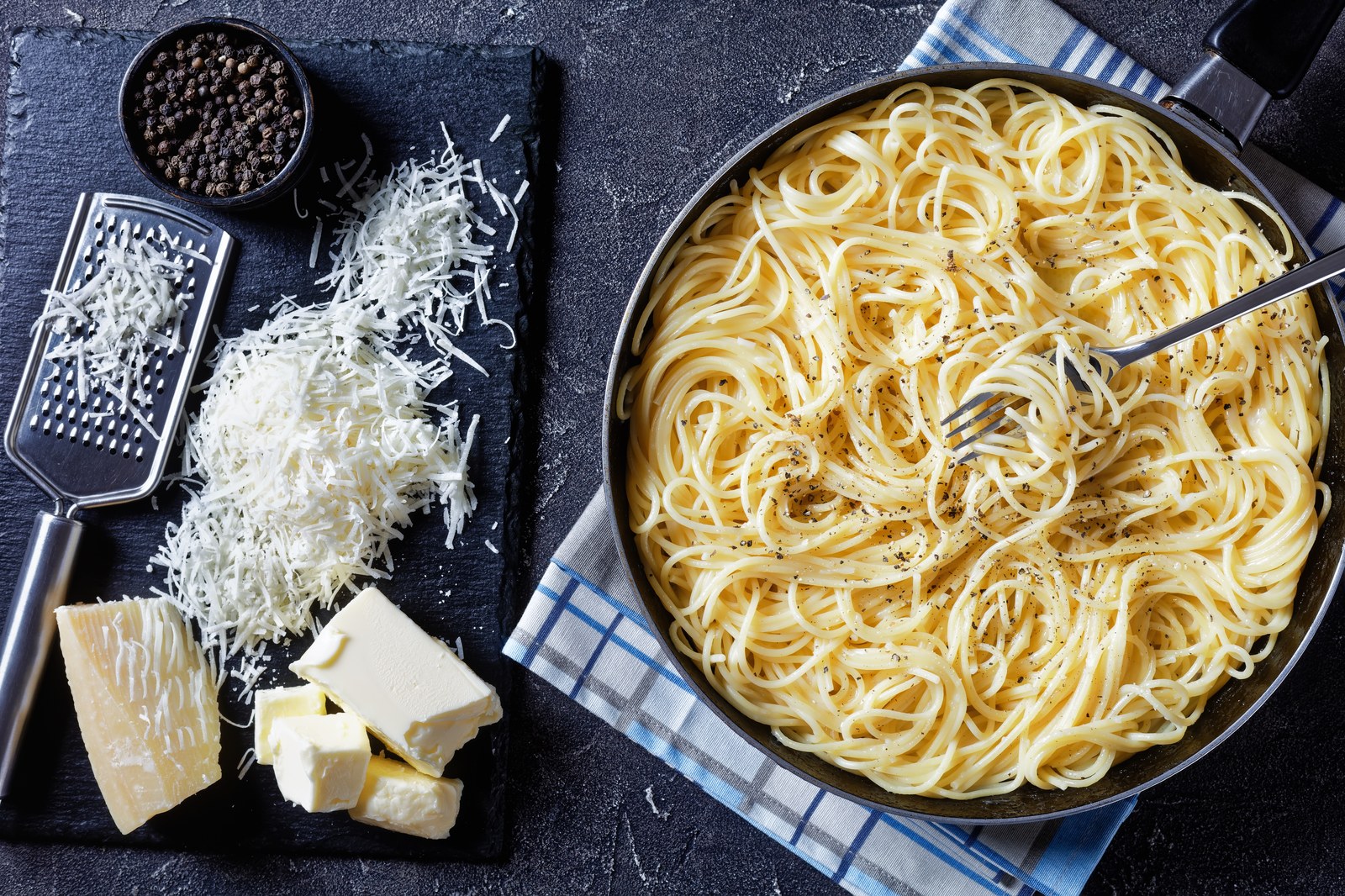
Before you cook
Background Recipe story & origin
Cacio e pepe—literally 'cheese and pepper'—is one of Rome's oldest pasta dishes, with roots stretching back to the shepherds of ancient Lazio. For centuries, transhumant shepherds drove their flocks between the lowland pastures near Rome and the high Apennine meadows, spending weeks or months away from home. They carried provisions that wouldn't spoil: dried pasta, hard aged Pecorino Romano, and dried black peppercorns. From these three ingredients, they built a sustaining meal over an open fire, and a culinary tradition was born.nnThe dish's genius lies in its constraints. With no cream, no butter, and no olive oil in the original form, the sauce depends entirely on technique—the careful emulsification of finely grated Pecorino with starchy pasta cooking water and freshly cracked pepper. Black pepper was not merely a seasoning but a functional ingredient, believed to generate body heat and ward off the cold of mountain nights. Pecorino Romano, produced in the hills outside Rome since at least the first century AD, provided fat, salt, and protein in a single compact wheel that could survive weeks without refrigeration.nnCacio e pepe is one of Rome's four canonical pasta dishes—alongside carbonara, amatriciana, and gricia—that form the backbone of cucina romana. While restaurants around the world have softened the recipe with cream or butter, Romans regard such additions as a fundamental misunderstanding of the dish. The authentic version remains stubbornly minimal: pasta, cheese, pepper, and water. Its enduring appeal is a testament to the idea that technique and restraint can produce something far greater than the sum of its parts.
Before you start Equipment you'll need
- large pot — Provides ample space and rolling boil for cooking pasta until perfectly al dente texture
- large skillet — Provides controlled heat for building creamy pasta sauces with proper temperature control
Safety Safety & allergen notes
- Hot skillet and pasta water can cause severe burns — use pot holders when handling and keep hands away from steam
- Boiling water reaches 212°F — add pasta carefully to avoid splashing and scalding
- Tossing hot pasta over heat can cause burns — use long-handled tongs and keep face away from steam
- Pecorino cheese will be very hot when melting — add gradually and stir with caution to avoid splashing onto skin
- Serve immediately on warmed plates to prevent burns from hot pasta — warn diners that plates and food remain extremely hot
Non-negotiables Rules for success
-
Cook pasta just shy of al dente, not fully al dente
Pasta continues cooking when tossed with hot pepper water and cheese; fully cooked pasta becomes mushy and breaks apart during emulsification
-
Reserve 2 cups pasta water before draining
Starch in pasta water is essential to create the emulsion; without it, cheese clumps instead of forming a silky sauce
-
Remove skillet from heat before adding cheese
High heat causes cheese proteins to seize and separate into grease; off-heat allows gradual melting into a creamy emulsion
-
Add cheese gradually while tossing constantly
Slow incorporation allows cheese to disperse evenly and emulsify with starch; adding it all at once creates clumps
-
Use less salt in pasta water than usual
Pecorino Romano is already very salty; over-salting the pasta water makes the final dish inedibly salty
Prep Get set first
About 8 min of prep
- Set out large pot and large skillet
- Measure and crack 2 tbsp black peppercorns
- Grate 2 cups Pecorino Romano finely
- Measure 1 lb pasta
- Measure 1 tbsp salt
- Have 2+ cups pasta water reserved nearby
This is a quick 20-minute dish that demands focus and speed during the emulsion stage—have everything prepped and ready to go.
Ingredients
Instructions
Unlock Grouped Step Actions
Plus members get tap-to-check action steps and live ingredient swaps for this recipe.
-
Bloom the pepper
Toast cracked pepper in dry skillet until fragrant, 1-2 minutes. Add 1 cup water, simmer to infuse.
-
Boil the pasta
Cook pasta in lightly salted water (less salt than usual — cheese is salty). Cook until just shy of al dente, then reserve 2 cups pasta water before draining.
-
Create the emulsion
Add pasta to the pepper skillet with 1 cup pasta water. Toss vigorously over medium heat. Remove from heat and add Pecorino gradually, tossing constantly. Add more pasta water as needed for a creamy sauce.
-
Serve
Plate immediately and top with extra cracked pepper and grated Pecorino.
Chef's notes
Use freshly ground black pepper for best flavor and texture
Pecorino Romano can be substituted with Parmigiano-Reggiano for a milder taste
Pasta water should be starchy; reserve at least 1 cup before draining
Toss pasta with cheese and pepper off heat to prevent clumping
Serve immediately in warmed bowls to maintain creamy consistency
Tomorrow's Meal
Crispy Cacio e Pepe Pasta Cake
Leftover pasta pressed into a cake, pan-fried until the edges turn golden and crispy while the center stays creamy
You'll need to pick up:
Quick overview:
- Press cold cacio e pepe into a compact cake about 1 inch thick
- Heat 2 tablespoons butter in a large skillet over medium-high heat
- Carefully slide pasta cake into pan, fry 4-5 minutes until bottom is golden and crispy
- Flip gently and fry another 3-4 minutes until second side crisps
- Transfer to plate, top with fresh pepper and grated Pecorino, serve immediately