Before you cook
Background Recipe story & origin
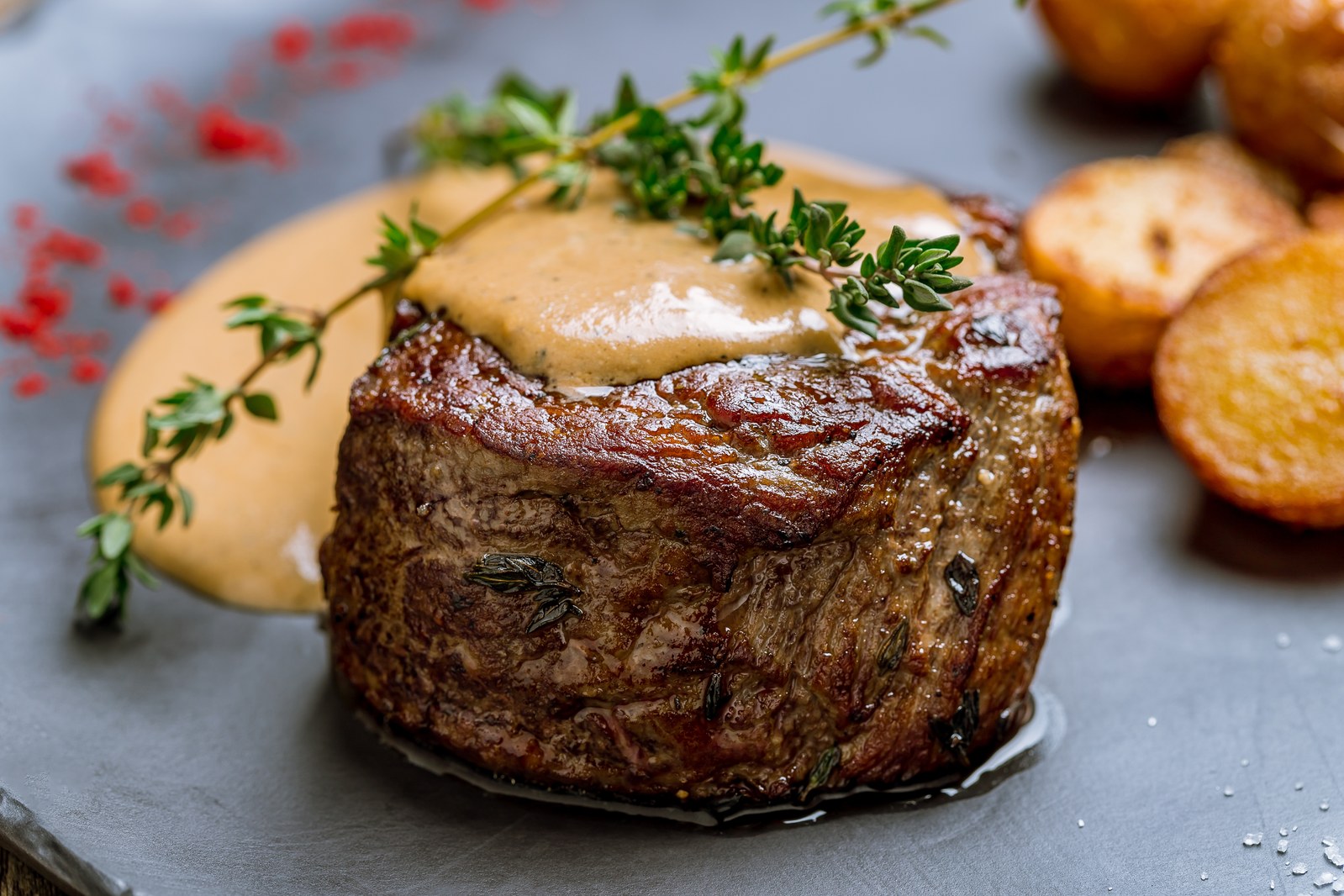
Filet mignon with Béarnaise represents classical French steakhouse cuisine. The filet (tenderloin) is beef's most tender cut, though not its most flavorful; sauce compensates for mild taste. Béarnaise—created in 1836 at Pavillon Henri IV near Paris—is hollandaise's sophisticated cousin, adding tarragon, shallots, and vinegar reduction. The pairing became standard in French restaurants and steakhouses worldwide. American steakhouses adopted it in the mid-20th century as French cuisine influenced fine dining. The dish requires two techniques: properly seared steak (caramelized crust, pink interior) and stable emulsified sauce. Béarnaise's tarragon notes complement beef's richness. The combination exemplifies the French approach: improving mild protein with complex sauce. Filet Béarnaise remains a steakhouse standard, though modern tastes sometimes prefer unadorned ribeye. The dish represents classical French influence on American fine dining.
Before you start Equipment you'll need
- cast iron skillet — Provides high heat retention for searing filet mignon with proper temperature control and browning
- small saucepan — Provides controlled heat for reducing tarragon-shallot-vinegar mixture to concentrated flavor base
- heatproof bowl — Provides gentle indirect heat for making Béarnaise sauce over simmering water without curdling eggs
- whisk — Essential tool for whisking and emulsifying egg yolks with butter creating smooth stable Béarnaise sauce
Safety Safety & allergen notes
- Béarnaise can break if overheated; keep heat low and whisk constantly.
- If sauce looks oily or curdled, remove from heat and whisk in cold water.
- Filets are thick; use a thermometer to avoid over or undercooking.
Non-negotiables Rules for success
-
Make the reduction first and strain it.
The reduction is the flavor base; unstrained shallot bits create bad texture
-
Keep heat very low when making sauce.
High heat scrambles yolks; you want slow thickening, not chunks
-
Add butter gradually.
Too much at once breaks the emulsion; slow addition creates stable sauce
-
Use a thermometer for filets.
Filets are expensive; 125°F for rare, 130°F for medium-rare
Prep Get set first
About 10 min of prep
- Remove filets from fridge 45 minutes ahead
- Mince shallot very fine
- Chop tarragon, reserve whole leaves for garnish
- Separate egg yolks
- Cube butter and soften slightly
- Set up bowl over simmering water
Béarnaise intimidates people but it's just a warm emulsion. Keep heat low, whisk constantly, add butter slowly. If it breaks, cold water and whisking usually saves it.
Ingredients
Instructions
Unlock Grouped Step Actions
Plus members get tap-to-check action steps and live ingredient swaps for this recipe.
-
Temper and season filets
Remove filets from refrigerator 45 minutes before cooking. Pat dry. Season generously with salt and pepper on all sides.
-
Make the reduction
Combine shallot, vinegar, wine, and half the tarragon in small saucepan. Simmer until reduced to about 2 tablespoons, 8-10 minutes. Strain into a bowl, pressing on solids. Discard solids.
-
Make the Béarnaise
Set a heatproof bowl over barely simmering water. Add egg yolks and strained reduction. Whisk constantly until yolks thicken slightly, about 2 minutes. Begin adding butter a few cubes at a time, whisking constantly until each addition is incorporated before adding more. Continue until all butter is added and sauce is thick and creamy. Remove from heat. Stir in remaining tarragon, cayenne, and salt to taste. Keep warm.
-
Sear the filets
Heat cast iron over high heat. Add oil. When smoking, add filets. Sear 4 minutes per side for medium-rare (130°F). Rest 5 minutes.
-
Spoon Béarnaise over
Place filets on plates. Spoon Béarnaise generously over the top or serve on the side.
Chef's notes
SHOPPING: Look for filet mignon cut at least 1.5 inches thick. Meat should be deep red with little visible fat. This lean cut relies on cooking, not marbling, for flavor. Center-cut filets are most uniform.
Béarnaise is Hollandaise's daughter, differing in the tarragon-shallot reduction.
Sauce keeps warm for 30 minutes over barely warm water.
Fresh tarragon is essential; dried won't work.