Before you cook
Background Recipe story & origin
Grilled chicken thighs represent a convergence of two culinary traditions: the ancient practice of cooking meat over fire, documented in Mediterranean and Asian cuisines for thousands of years, and the American barbecue culture that emerged in the 1950s and 1960s. While early barbecue in the American South focused primarily on pork and beef, chicken became increasingly popular as refrigeration improved and poultry farming industrialized, making it more affordable and accessible to home cooks.nnThe combination of grilled chicken with fruit-based glazes gained prominence during the post-World War II era, when suburban American cooking embraced convenience and experimentation. Home economists and food writers began publishing recipes that paired grilled proteins with sweet and savory glazes, reflecting the era's fascination with fusion flavors and restaurant-quality cooking at home. Balsamic vinegar, once a regional Italian specialty, became widely available in American grocery stores during the 1980s gourmet food boom, making sophisticated glazes with aged vinegar and fresh fruit accessible to home cooks beyond professional kitchens.nnChicken thighs specifically gained favor among grilling enthusiasts for their superior flavor and forgiving nature compared to leaner white meat—the higher fat content keeps them moist during cooking. The blackberry-balsamic combination exemplifies contemporary American cooking: drawing on Italian vinegar traditions, American barbecue methodology, and the modern farm-to-table movement's emphasis on seasonal fruits and bold flavor pairings. This dish represents the evolution of American grilling from simple meat-over-fire to sophisticated home entertaining.
Before you start Equipment you'll need
- grill (gas or charcoal) — creates char and caramelization on chicken skin while glaze sets; direct and indirect heat zones control cooking speed
- small saucepan — reduces glaze to proper consistency and allows balsamic-blackberry mixture to concentrate without scorching
- instant-read thermometer — confirms chicken reaches 165°F internal temperature without overcooking
- silicone or pastry brush — applies glaze evenly during final grilling phase without dripping
Safety Safety & allergen notes
- Hot saucepan and reduced glaze can cause severe burns - use pot holders when handling and keep hands away from steam when straining
- Chicken must reach 165°F internal temperature at thickest part to prevent foodborne illness - use meat thermometer to verify doneness
- Grill grates reach 400°F+ and remain extremely hot - use long-handled tongs or grilling tools, never touch grates directly, and keep hands clear of flames
- Hot glaze can splatter when brushing onto chicken - use a silicone brush and apply carefully to avoid contact with skin
Non-negotiables Rules for success
-
Strain glaze and simmer until it coats the back of a spoon
Proper reduction concentrates flavors and creates a thick glaze that clings to chicken instead of running off; under-reduced glaze will slide off during grilling
-
Pat chicken thighs completely dry before seasoning
Moisture prevents proper browning and crispy skin formation; dry surfaces allow the Maillard reaction to create golden, flavorful crust
-
Do not move chicken for first 6-7 minutes skin-side down
Undisturbed contact with hot grates allows skin to render fat and crisp properly; moving prematurely tears skin and prevents even browning
-
Move chicken to cooler zone after flipping
Reduces direct high heat to prevent burning while interior finishes cooking; ensures even cooking throughout without charring exterior
-
Apply glaze only in final 2-3 minutes of cooking
Glaze contains sugar that burns easily over prolonged heat; late application caramelizes glaze without scorching it, creating glossy coating
-
Let chicken rest 5 minutes before serving
Resting allows residual heat to distribute evenly and juices to reabsorb into meat; cutting immediately causes juices to run out, resulting in dry chicken
Prep Get set first
About 8 min of prep
- Gather fresh blackberries, balsamic vinegar, and fresh thyme
- Have small saucepan and fine-mesh sieve ready
- Pat chicken thighs dry with paper towels
- Measure out kosher salt and freshly ground black pepper
- Prepare grill and have neutral oil on hand
- Set out instant-read thermometer or prepare visual check method
- Have silicone brush or spoon ready for glazing
Active prep takes about 8 minutes; total cooking time is 56 minutes, so plan for roughly 1 hour from start to table.
Ingredients
Instructions
Unlock Grouped Step Actions
Plus members get tap-to-check action steps and live ingredient swaps for this recipe.
-
Prepare the glaze
Combine fresh blackberries, balsamic vinegar, and fresh thyme in a small saucepan over medium heat. Simmer until blackberries break down and liquid reduces by half, stirring occasionally. Strain glaze through a fine-mesh sieve, pressing berries gently to extract all liquid; discard solids. Return glaze to saucepan and simmer 2–3 minutes more until glossy and coat-the-back-of-a-spoon consistency.
-
Season and prepare chicken
Pat bone-in chicken thighs dry with paper towels. Season bone-in chicken thighs generously on both sides with kosher salt and freshly ground black pepper.
-
Preheat and set up grill
Preheat grill to medium-high (about 400°F); oil grates well with neutral oil.
-
Grill chicken skin-side down
Place bone-in chicken thighs skin-side down on grill over medium-high heat; do not move for 6–7 minutes until skin is golden and crispy. Flip bone-in chicken thighs and move to medium heat or cooler zone of grill. Cook 12–15 minutes more until internal temperature reaches 165°F at the thickest part.
-
Glaze and finish
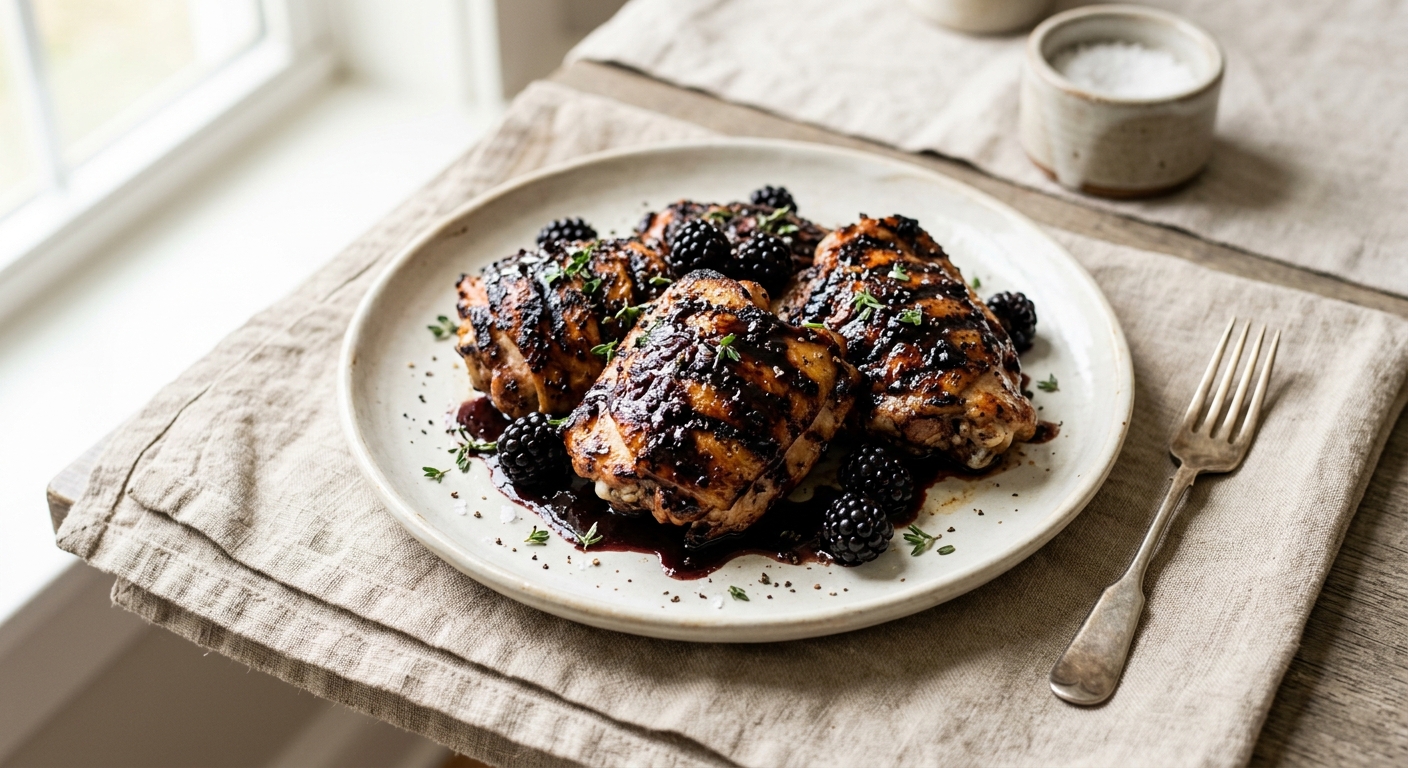
Brush blackberry-balsamic glaze generously over bone-in chicken thighs during the final 2–3 minutes of cooking, turning once to coat both sides. Transfer bone-in chicken thighs to a serving platter and let rest 5 minutes. Drizzle any remaining blackberry-balsamic glaze over bone-in chicken thighs and serve immediately.
Chef's notes
Pat chicken skin dry before seasoning to promote crispness and char.
Make the glaze up to 2 days ahead; refrigerate and rewarm gently before brushing on chicken.
If blackberries are tart, add 1 teaspoon honey or sugar to the glaze reduction.
Oil grill grates well to prevent sticking; chicken skin will release naturally once a crust forms.
Let cooked chicken rest 5 minutes before serving so juices redistribute.
Substitute fresh raspberries or blueberries if blackberries are unavailable; reduce cooking time by 1–2 minutes.