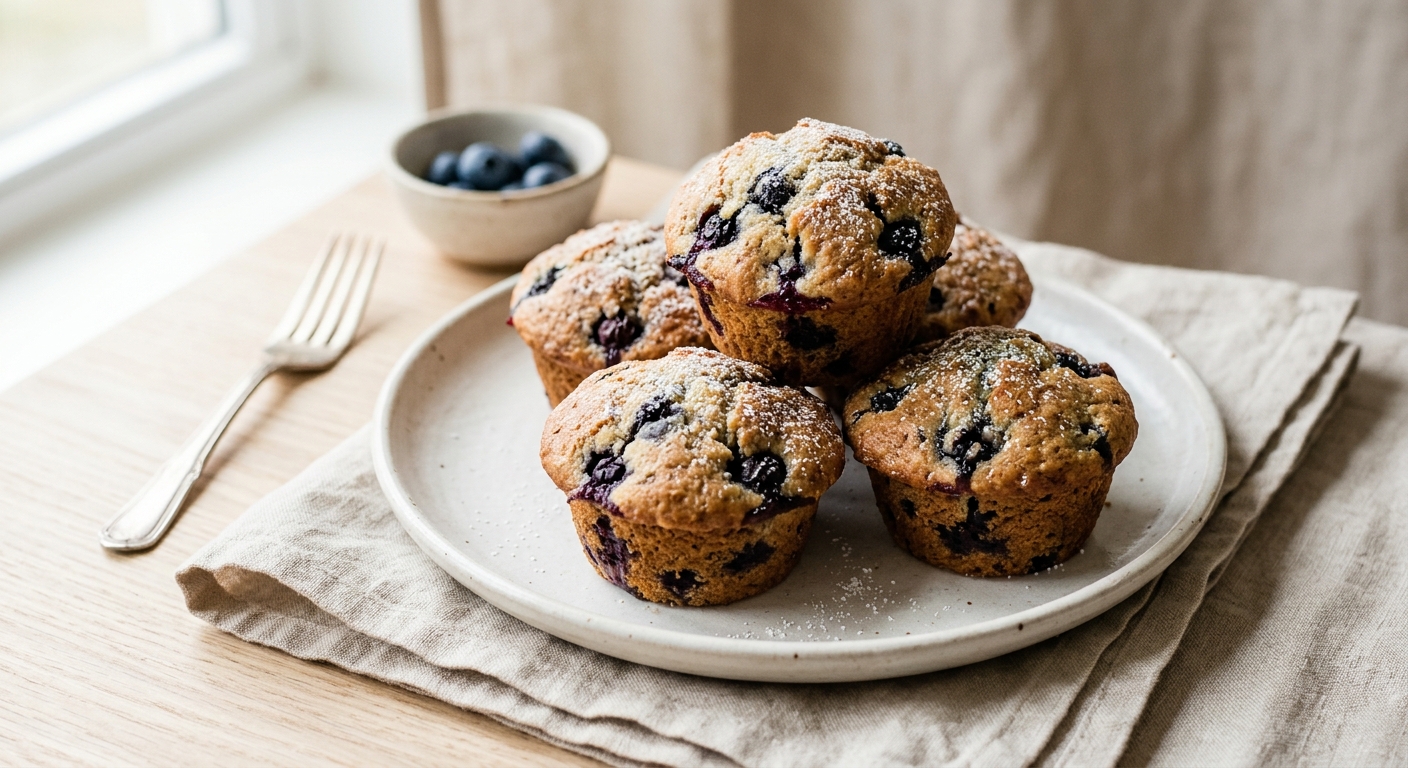
Before you cook
Background Recipe story & origin
The story of blueberry muffins is inseparable from the story of the blueberry itself, one of the only major fruits indigenous to North America. Native American tribes had been harvesting and drying wild blueberries for centuries before European settlers arrived, using them in pemmican, stews, and medicinal preparations. Colonists quickly adopted the berry, and by the 1800s, blueberries were a beloved fixture of New England cooking, folded into puddings, pies, and the quick breads that were a staple of the American kitchen.nnThe muffin as Americans know it—a individually portioned, leavened quick bread baked in a tin—took shape in the 19th century, distinct from the flat, yeast-risen English muffin. Early American cookbooks from the 1800s began featuring muffin recipes, and blueberries, abundant in the wild across the Northeast, were a natural addition. The combination became especially beloved in Maine and Massachusetts, where wild lowbush blueberries grew in coastal barrens and were harvested each summer as a seasonal ritual. By the early 20th century, blueberry muffins had cemented their place as a New England breakfast and tea-time classic.nnThe commercial cultivation of highbush blueberries, pioneered by botanist Frederick Coville and New Jersey farmer Elizabeth White in the 1910s and 1920s, transformed the blueberry muffin from a seasonal treat into a year-round staple. As cultivated blueberries became widely available in grocery stores by mid-century, the muffin spread far beyond New England, becoming a fixture of diners, bakeries, and home kitchens across the country. Today, blueberry muffins are one of the most popular baked goods in America, a humble but beloved symbol of homestyle baking with roots stretching back to the continent's earliest inhabitants.
Safety Safety & allergen notes
- Oven racks and interior surfaces reach 400°F - use oven mitts when placing muffin tin inside and removing it
- Hot muffin tin and muffins can cause severe burns - allow 5 minutes cooling time in tin before handling, then use a spatula to transfer to wire rack
- Keep hands and face away from oven opening to avoid steam burns when checking muffin doneness
- Toothpick is sharp - handle carefully when testing muffins and dispose of properly after use
Non-negotiables Rules for success
-
Do not overmix when combining wet and dry ingredients
Overmixing develops gluten, creating tough, dense muffins instead of tender, light crumb structure
-
Toss blueberries with flour before folding into batter
The flour coating prevents berries from sinking to the bottom during baking and distributes them evenly throughout
-
Fill muffin cups only two-thirds full
Overfilling causes batter to overflow during baking and prevents proper rise and dome formation
-
Test doneness by inserting toothpick away from berries
Hitting a blueberry gives a false positive for doneness; testing the cake itself ensures proper internal baking
-
Cool in tin for 5 minutes before transferring to rack
This brief rest allows the muffin structure to set enough to release cleanly from the cups without breaking apart
Prep Get set first
About 8 min of prep
- Preheat oven to 400°F
- Line or grease 12-cup muffin tin
- Gather all ingredients (flour, baking powder, salt, sugar, oil, eggs, milk, vanilla, blueberries)
- Prepare medium and large mixing bowls
- Have whisk, spatula, small bowl, and toothpick ready
- Set out wire cooling rack
About 30 minutes total from start to finish, with 18-22 minutes of baking time and 5+ minutes cooling.
Ingredients
Instructions
Unlock Grouped Step Actions
Plus members get tap-to-check action steps and live ingredient swaps for this recipe.
-
Preheat oven and prepare muffin tin
Preheat your oven to 400°F. Line a 12-cup muffin tin with paper liners or grease the cups lightly.
-
Combine dry ingredients
In a medium bowl, whisk together 2 cups flour, baking powder, and salt until combined.
-
Cream sugar and oil, then add eggs
In a large bowl, whisk together sugar and oil until combined. Add eggs one at a time, whisking well after each addition.
-
Add milk and vanilla to wet mixture
Whisk milk and vanilla extract into the egg mixture until smooth.
-
Combine wet and dry ingredients
Pour the wet ingredients into the dry ingredients and stir with a spatula until just combined; do not overmix (a few lumps are fine).
-
Fold blueberries into batter
Toss the blueberries with 1 tablespoon flour in a small bowl, then gently fold them into the batter.
-
Fill muffin cups
Divide the batter evenly among the muffin cups, filling each about two-thirds full.
-
Bake muffins
Bake for 18 to 22 minutes, until a toothpick inserted into a muffin (avoiding a berry) comes out clean and the tops are golden brown.
-
Cool muffins
Let the muffins cool in the tin for 5 minutes, then transfer to a wire rack to cool completely.
Chef's notes
Store cooled muffins in an airtight container at room temperature for up to 3 days
For extra-moist muffins, brush the warm muffin tops lightly with melted butter and sprinkle with a little sugar
Buttermilk can replace regular milk for a tangier flavor and slightly more tender crumb
Muffin batter can be prepared up to 2 hours ahead; fold in blueberries just before baking