Before you cook
Background Recipe story & origin
The story of potato soup begins with the potato itself, which Spanish conquistadors brought back from the Andes Mountains of South America to Europe in the mid-1500s. Initially viewed with suspicion—some Europeans even believed potatoes were poisonous—the tuber slowly won over the continent's poorest communities, who discovered it could be grown cheaply, stored through winter, and stretched into filling meals. By the 17th and 18th centuries, potato soup had become a cornerstone of peasant cooking across Ireland, Germany, France, and Eastern Europe, where it was often little more than boiled potatoes, water, and salt.nnIreland arguably elevated potato soup to its most culturally significant form. As the Irish population became increasingly dependent on the potato throughout the 1700s and early 1800s, simple potato-based soups and stews fed entire families. The Great Famine of 1845–1852, caused by a potato blight, devastated Ireland precisely because so many depended on this single crop—a grim testament to how central the potato had become to daily survival. Irish immigrants carried their potato cooking traditions to America, where the dish took on new richness with the addition of cream, butter, and bacon as prosperity allowed.nnAcross different cultures, classic potato soup evolved in distinct directions: the French developed the elegant vichyssoise (a chilled, cream-enriched version credited to chef Louis Diat around 1917), while German cooks favored hearty versions loaded with sausage and leeks, and American home cooks settled on the creamy, loaded version topped with cheese, sour cream, and chives that became a beloved comfort food staple. Today's classic potato soup is a democratic dish—simple enough for a weeknight dinner yet deeply satisfying, carrying centuries of resourceful, nourishing cooking in every bowl.
Safety Safety & allergen notes
- Keep hands and face away from the pot when bacon splatters - hot grease can cause severe burns
- Use a sharp knife for dicing vegetables to prevent slipping and cuts - dull knives require more pressure
- Stir the roux constantly to prevent flour from burning and creating hot spots that can splatter
- Keep pot handles turned inward and use pot holders when handling the large pot - the soup reaches boiling temperatures
- When mashing potatoes, be careful of steam rising from the hot soup - keep your face away from the pot
- Remove bay leaves completely before mashing and serving - they are a choking hazard if swallowed
Non-negotiables Rules for success
-
Dice potatoes into uniform 0.5-inch cubes
Uniform size ensures even cooking; larger pieces stay hard while smaller pieces become mushy
-
Stir constantly while making the roux for 1-2 minutes
Constant stirring cooks out the raw flour taste and prevents lumps from forming when broth is added
-
Pour broth slowly while stirring continuously
Slow addition prevents flour lumps from forming; rapid pouring creates clumps that won't dissolve
-
Simmer until potatoes are very tender, not just soft
Very tender potatoes mash easily to thicken soup; undercooked potatoes won't break down and create lumpy texture
-
Heat cream and cheese through without boiling
Boiling causes cream to curdle and separates, creating a grainy, broken texture instead of smooth soup
Prep Get set first
About 10 min of prep
- Peel and dice 4 medium russet potatoes into 0.5-inch cubes
- Dice 1 medium yellow onion
- Mince 3 garlic cloves
- Chop 4 slices bacon (if using)
- Chop 2 tablespoons fresh chives
- Measure out all spices: salt, black pepper, dried thyme
- Have 4 cups broth, 1 cup heavy cream, and 0.5 cup cheese (if using) ready
- Gather equipment: large pot, wooden spoon, potato peeler, cutting board, chef's knife, measuring cups/spoons, ladle
This soup takes about 40-50 minutes total, with 10 minutes prep and 30-40 minutes of active cooking and simmering.
Ingredients
Instructions
Unlock Grouped Step Actions
Plus members get tap-to-check action steps and live ingredient swaps for this recipe.
-
Prepare vegetables
Peel and dice the potatoes into 0.5-inch cubes. Dice the onion and mince the garlic.
-
Cook bacon (if using)
If using bacon, cook it in a large pot over medium heat until crispy, then remove and set aside, leaving 2 tablespoons of fat in the pot.
-
Sauté onion
In the same pot, melt the butter over medium heat and add the diced onion, cooking for 3-4 minutes until softened.
-
Add garlic
Add the minced garlic and cook for another minute until fragrant.
-
Make the roux
Sprinkle the flour over the onion and garlic mixture, stirring constantly for 1-2 minutes to create a roux.
-
Build the soup
Slowly pour in the broth while stirring to avoid lumps, then add the diced potatoes, salt, pepper, thyme, and bay leaves.
-
Simmer the soup
Bring the soup to a boil, then reduce heat and simmer for 15-20 minutes until the potatoes are very tender.
-
Thicken the soup
Remove the bay leaves and carefully mash some of the potatoes against the side of the pot to thicken the soup, leaving some chunks for texture.
-
Finish with cream and cheese
Stir in the heavy cream and cheese (if using), heating through but not boiling.
-
Season and serve
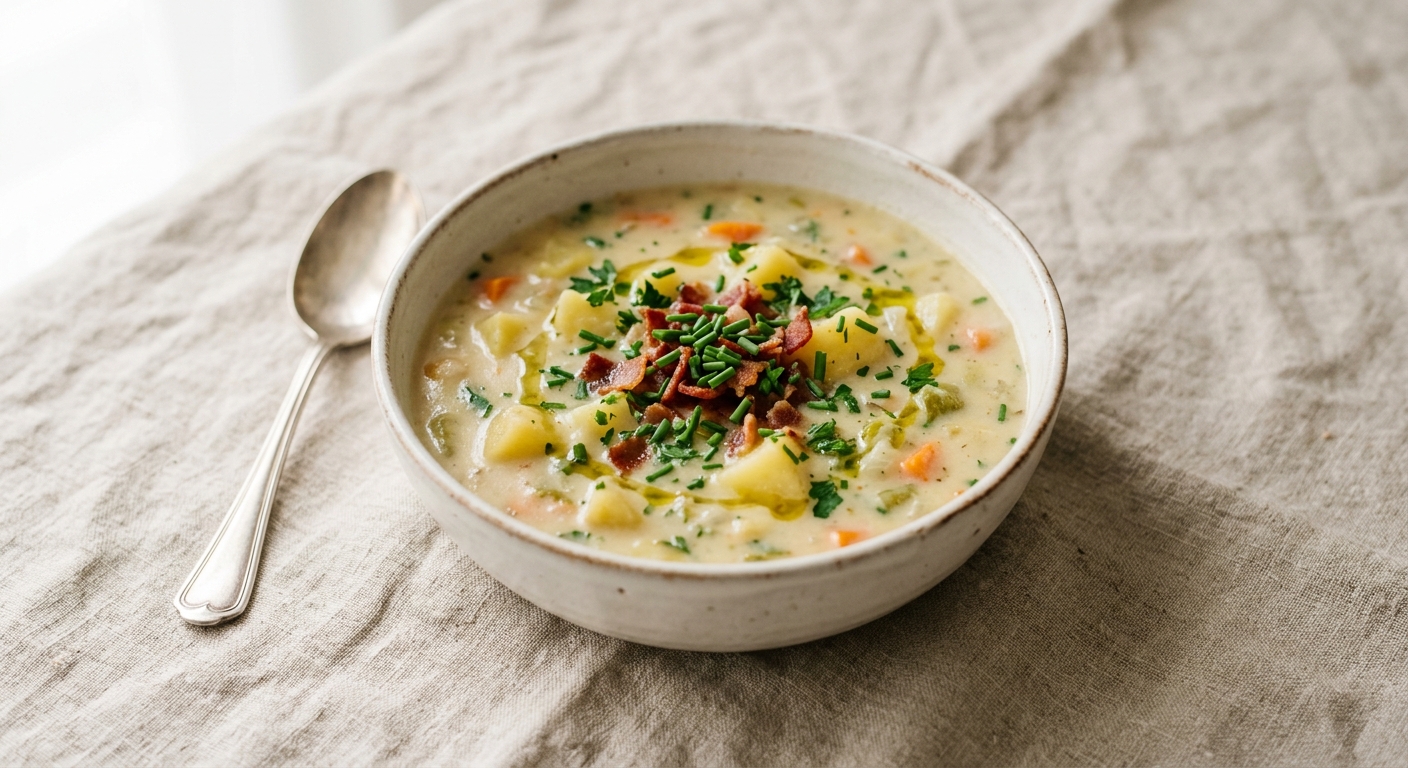
Taste and adjust seasoning as needed, then ladle into bowls and top with cooked bacon pieces and fresh chives.
Chef's notes
For a lighter version, substitute the heavy cream with milk or use a 50/50 blend of broth and cream.
Serve hot with crusty bread, oyster crackers, or a grilled cheese sandwich on the side.
Can be made up to 1 day ahead and reheated gently before serving.
Tomorrow's Meal
Crispy Potato Soup Cakes with Cheese
Thickened leftover potato soup chilled, formed into patties, and pan-fried until golden and crispy on the outside with creamy center
You'll need to pick up:
Quick overview:
- Chill leftover soup until thick and cold (at least 2 hours)
- Form into 3-inch patties about 1 inch thick
- Heat 2 tablespoons butter in skillet over medium-high heat
- Fry patties 3-4 minutes per side until golden brown and crispy
- Top with sour cream and fresh chives, serve hot