Before you cook
Background Recipe story & origin
The story of French onion soup stretches back centuries, but its modern identity was forged in the bustling markets and taverns of 18th-century Paris. Onions had long been a cornerstone of the French peasant diet — cheap, plentiful, and capable of coaxing deep, sweet flavor from almost nothing. Early versions of the soup were little more than onions simmered in water, a survival food for those who could afford little else. But French cooks, with their instinct for coaxing greatness from humble ingredients, slowly elevated the dish by caramelizing the onions low and slow, building layers of rich, complex sweetness that belied its simple origins.nnThe soup found its spiritual home in the Les Halles district of Paris, the city's legendary central market that operated from the 12th century until 1971. Market workers, butchers, and merchants would gather in the early morning hours at surrounding bistros to warm themselves with deep bowls of the soup, often topped with a thick crust of bread and bubbling Gruyère cheese. This gratinéed version — the one the world now recognizes — became the definitive preparation, and Les Halles-style onion soup became a Parisian institution. It was famously said to be the perfect antidote to a long night, earning it a reputation as a restorative cure-all among Parisians of every social class.nnFrench onion soup crossed the Atlantic in earnest during the 20th century, helped along by the postwar American fascination with French cuisine and later by Julia Child, whose 1961 cookbook 'Mastering the Art of French Cooking' brought the recipe into American home kitchens. Today it appears on menus from Parisian brasseries to American steakhouses, its formula largely unchanged: slowly caramelized onions, a rich beef broth, a raft of toasted bread, and a molten crown of melted cheese. Few dishes in the Western culinary canon so perfectly illustrate how patience, technique, and tradition can transform the ordinary into the extraordinary.
Safety Safety & allergen notes
- Keep hands and face away from the pot when heating butter and oil - hot fat can splatter when onions are added
- Use a long-handled wooden spoon when stirring to keep hands away from steam and hot pot surfaces
- The pot handle remains extremely hot throughout cooking - always use pot holders or oven mitts when handling
- When deglazing with wine, pour slowly to prevent steam burns and splashing of hot liquid
- Broiler heating elements reach over 500°F - keep hands clear and watch bread closely to prevent burning
- Oven-safe bowls will be extremely hot after broiling - use oven mitts or tongs when removing from broiler and handling bowls
- Do not touch melted cheese or hot soup - risk of severe burns to mouth and hands
Non-negotiables Rules for success
-
Slice onions to uniform 0.25 inch thickness
Uniform thickness ensures even cooking and caramelization; thicker pieces stay firm while thin pieces burn
-
Use medium-low heat during 45-50 minute caramelization phase
High heat scorches onions and creates bitter burnt flavor instead of sweet caramelized notes; low heat allows natural sugars to slowly convert to complex caramel compounds
-
Stir frequently during caramelization, especially in final 15 minutes
Prevents bottom from burning and ensures even browning; unstirred onions develop burnt spots that ruin the entire batch
-
Scrape up all browned bits when deglazing with wine
Browned bits contain concentrated umami and caramelized flavors that dissolve into liquid; skipping this step loses essential depth of flavor
-
Use oven-safe bowls and broil cheese until bubbly with light golden spots only
Over-broiling burns cheese and creates acrid flavor; under-broiling leaves it unmelted and separated from bread
Prep Get set first
About 10 min of prep
- Slice 4 large yellow onions into thin half-moons
- Measure butter (3 tbsp) and olive oil (1 tbsp)
- Gather salt, black pepper, and all-purpose flour
- Measure beef broth (6 cups) and dry white wine (0.5 cup)
- Prep bay leaves (2) and fresh thyme sprigs (2)
- Slice baguette into 0.5-inch rounds
- Shred Gruyère cheese (1.5 cups)
- Have wooden spoon, cutting board, and sharp knife ready
- Ensure oven-safe bowls and baking sheet are available
This French onion soup requires 1.5+ hours of mostly hands-off cooking time with significant active prep and stirring, so plan accordingly.
Ingredients
Instructions
Unlock Grouped Step Actions
Plus members get tap-to-check action steps and live ingredient swaps for this recipe.
-
Slice the onions
Slice the yellow onions into thin half-moons, about 0.25 inch thick.
-
Heat the fats
Heat the butter and olive oil in a large heavy-bottomed pot or Dutch oven over medium-high heat.
-
Begin cooking onions
Add the sliced onions, salt, and pepper, stirring occasionally until the onions begin to soften, about 10 minutes.
-
Caramelize the onions
Reduce heat to medium-low and continue cooking, stirring frequently, for 45-50 minutes until the onions are deeply caramelized and golden brown.
-
Make the roux
Sprinkle the all-purpose flour over the onions and stir constantly for 2 minutes to coat evenly.
-
Deglaze the pot
Deglaze the pot by pouring in the dry white wine and scraping up any browned bits from the bottom with a wooden spoon.
-
Build the broth
Add the beef broth, bay leaves, and thyme sprigs, stirring well to combine.
-
Simmer the soup
Bring the soup to a simmer and cook uncovered for 15-20 minutes to allow flavors to meld.
-
Prepare the garnish
While the soup simmers, preheat your oven broiler and slice the baguette into 0.5-inch thick rounds.
-
Toast the bread
Toast the bread slices under the broiler until golden brown, about 1-2 minutes per side.
-
Finish the soup
Stir the optional Cognac or brandy into the soup if using, then remove and discard the bay leaves and thyme sprigs.
-
Assemble the bowls
Ladle the soup into oven-safe bowls and place them on a baking sheet.
-
Add toppings
Top each bowl with a toasted bread slice and divide the shredded Gruyère cheese evenly among them.
-
Broil until melted
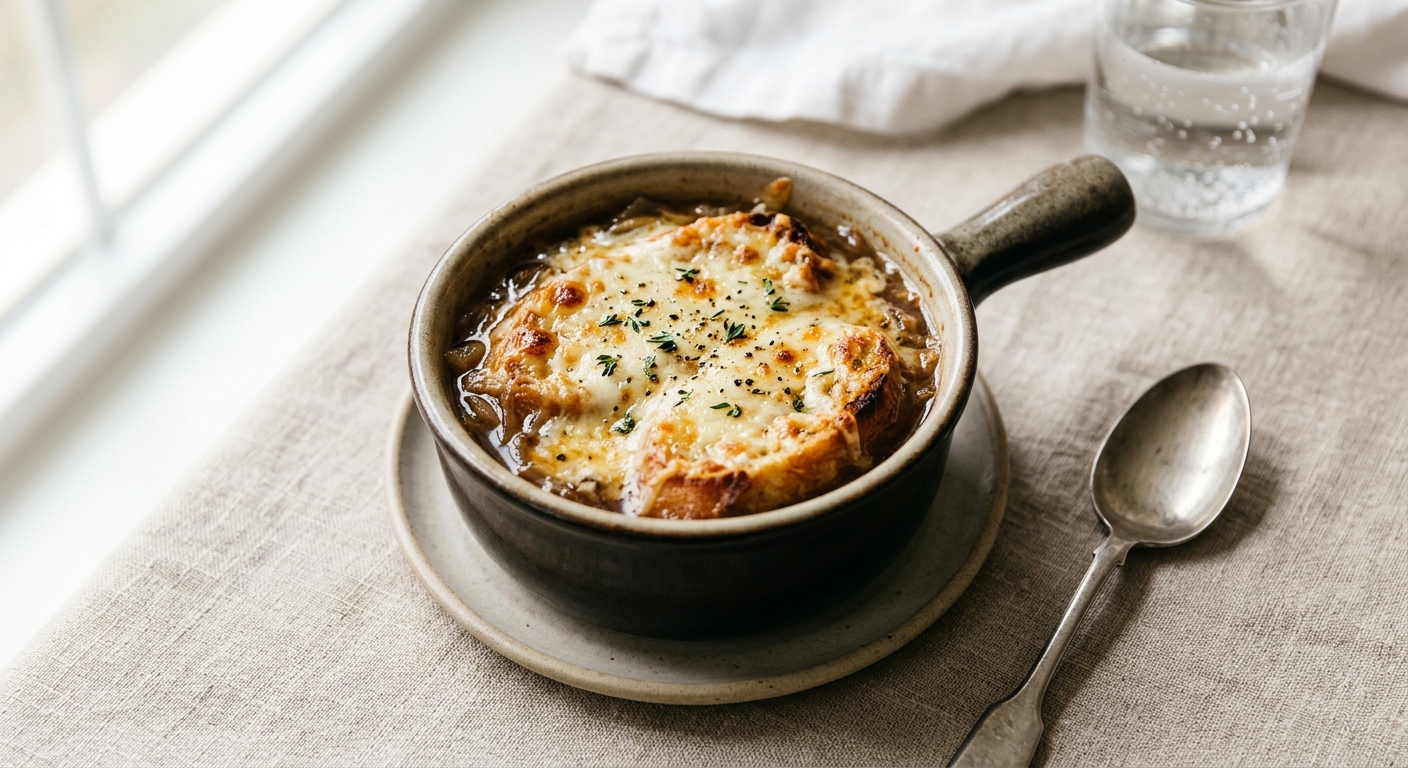
Place the bowls under the broiler for 3-4 minutes until the cheese is melted and bubbly with light golden spots.
Chef's notes
Serve immediately after broiling the cheese topping while hot and cheese is melted
For a lighter version, use half the cheese or substitute with Swiss cheese
Can be made up to 1 day ahead; store soup and cheese topping separately, then assemble and broil before serving
Tomorrow's Meal
French Onion Soup Gratinée Bread Salad
Leftover soup reheated and spooned over crusty bread cubes tossed with bitter greens, creating a warm bread salad with melted cheese and caramelized onions
You'll need to pick up:
Quick overview:
- Cut day-old crusty bread into 1-inch cubes and toast in 400°F oven for 8 minutes until golden
- Toss warm greens with light vinaigrette in a bowl
- Gently reheat soup on stovetop until steaming
- Pour hot soup over greens and bread cubes, allowing bread to absorb broth
- Top with additional Gruyère if desired, finish with fresh herbs