Before you cook
Background Recipe story & origin
Few fish have shaped human history as profoundly as the Atlantic cod. For centuries stretching back to at least the 10th century, Norse fishermen were drying and trading cod across Northern Europe, and by the 15th and 16th centuries, the Grand Banks off Newfoundland had become one of the most contested and valuable fishing grounds in the world. Cod was so central to the economies of Portugal, Spain, England, and New England that historian Mark Kurlansky famously devoted an entire book to its outsized role in shaping civilization. It fed armies, fueled the slave trade as ship provisions, and built the early wealth of Boston and other Atlantic port cities.nnThe technique of pan-searing cod with a crispy golden crust developed naturally in the coastal fishing communities of Western Europe and New England, where fishermen and their families needed fast, practical ways to cook fresh catches. Portuguese cooks perfected the art of achieving a golden crust on bacalhau, while French chefs in Normandy and Brittany elevated pan-seared cod into a refined bistro staple. The key discovery — pressing the fish firmly into a hot, oiled pan and resisting the urge to move it — transformed a humble ingredient into something with remarkable textural contrast: a shatteringly crisp exterior giving way to tender, flaky white flesh.nnBy the 20th century, pan-seared cod had become a restaurant and home kitchen classic across the Atlantic world, celebrated for its simplicity and speed. As concerns about sustainable fishing grew in the late 1900s following the catastrophic collapse of the Grand Banks cod stocks in the 1990s, cooks began paying closer attention to sourcing, but the technique itself remained unchanged — a timeless method that lets one of the ocean's most storied fish shine at its very best.
Safety Safety & allergen notes
- Oil will be extremely hot and may splatter when fish is added to the pan — keep face and bare skin away, use a splatter screen if available
- Use pot holders or oven mitts when handling the hot skillet at all times, especially when tilting to baste
- The pan handle remains dangerously hot throughout cooking — do not touch bare-handed and point handle away from edge to prevent accidental contact
- When basting with hot butter, use a long-handled spoon and keep fingers clear of steam and hot liquid to prevent burns
- Cod is safely cooked when opaque throughout; use a food thermometer (145°F internal temperature) to verify doneness if preferred
Non-negotiables Rules for success
-
Pat the fillets completely dry before cooking
Surface moisture creates steam that prevents browning; dry fish develops a crispy golden crust instead of a pale, steamed exterior
-
Heat the oil until it shimmers and barely smokes before adding fish
Insufficient heat causes the fish to steam and stick; properly heated oil creates immediate crust formation through the Maillard reaction
-
Do not move the fish during the first 4-5 minutes of searing
Moving breaks the forming crust and releases moisture back onto the surface; undisturbed contact allows a deep golden crust to develop
-
Press the fillet gently for only the first 10 seconds after placing in the pan
Initial pressure ensures full contact with the hot surface for even crust formation; continued pressing squeezes out moisture and prevents proper browning
-
Reduce heat to medium after flipping and baste continuously with foaming butter
High heat on the second side would overcook the exterior before the interior finishes; gentle heat with butter basting cooks the fish through while keeping the crust crispy
Prep Get set first
About 8 min of prep
- Remove cod fillets from refrigerator
- Paper towels ready for patting fish dry
- Small bowl for seasoning mixture
- Large skillet (12-inch stainless steel or cast iron) accessible
- Measure out neutral oil, butter, garlic cloves, and fresh thyme sprigs
- Fish spatula and basting spoon within reach
- Serving plate or platter ready
- Lemon cut and ready for squeezing
This recipe requires careful attention during cooking (about 12 minutes active time), so have all ingredients prepped and equipment ready before you start—the fish cooks quickly once the pan is hot.
Ingredients
Instructions
Unlock Grouped Step Actions
Plus members get tap-to-check action steps and live ingredient swaps for this recipe.
-
Temper the cod fillets
Remove the cod fillets from the refrigerator 20 minutes before cooking to allow them to come closer to room temperature, which promotes even cooking.
-
Pat the fillets dry
Pat the cod fillets thoroughly dry on all sides using paper towels. This step is critical — removing surface moisture is the key to achieving a crispy golden crust rather than steaming the fish.
-
Season the fillets
In a small bowl, combine the kosher salt, black pepper, and garlic powder. Season both sides of each fillet evenly with the spice mixture.
-
Heat the pan
Place a large stainless steel or cast iron skillet over medium-high heat. Add the neutral oil and heat until the oil begins to shimmer and just barely starts to smoke, about 2 minutes. The pan must be very hot before the fish goes in.
-
Sear the first side
Carefully lay the cod fillets in the pan, presentation side (the smoother, more attractive side) facing down. Press each fillet gently with a spatula for the first 10 seconds to ensure full contact with the pan and prevent curling. Cook without moving for 4 to 5 minutes, until a deep golden crust has formed and the cooked color has crept about halfway up the side of each fillet. The fish will release naturally when the crust is ready.
-
Flip and add aromatics
Reduce the heat to medium and carefully flip each fillet. Add the unsalted butter, garlic cloves, and fresh thyme sprigs to the pan.
-
Baste and finish cooking
As the butter melts and begins to foam, tilt the pan slightly and use a spoon to continuously baste the top of the fillets with the flavored butter for 2 to 3 minutes, until the fish is just cooked through. The flesh should be opaque and flake easily when pressed with a finger.
-
Plate and serve
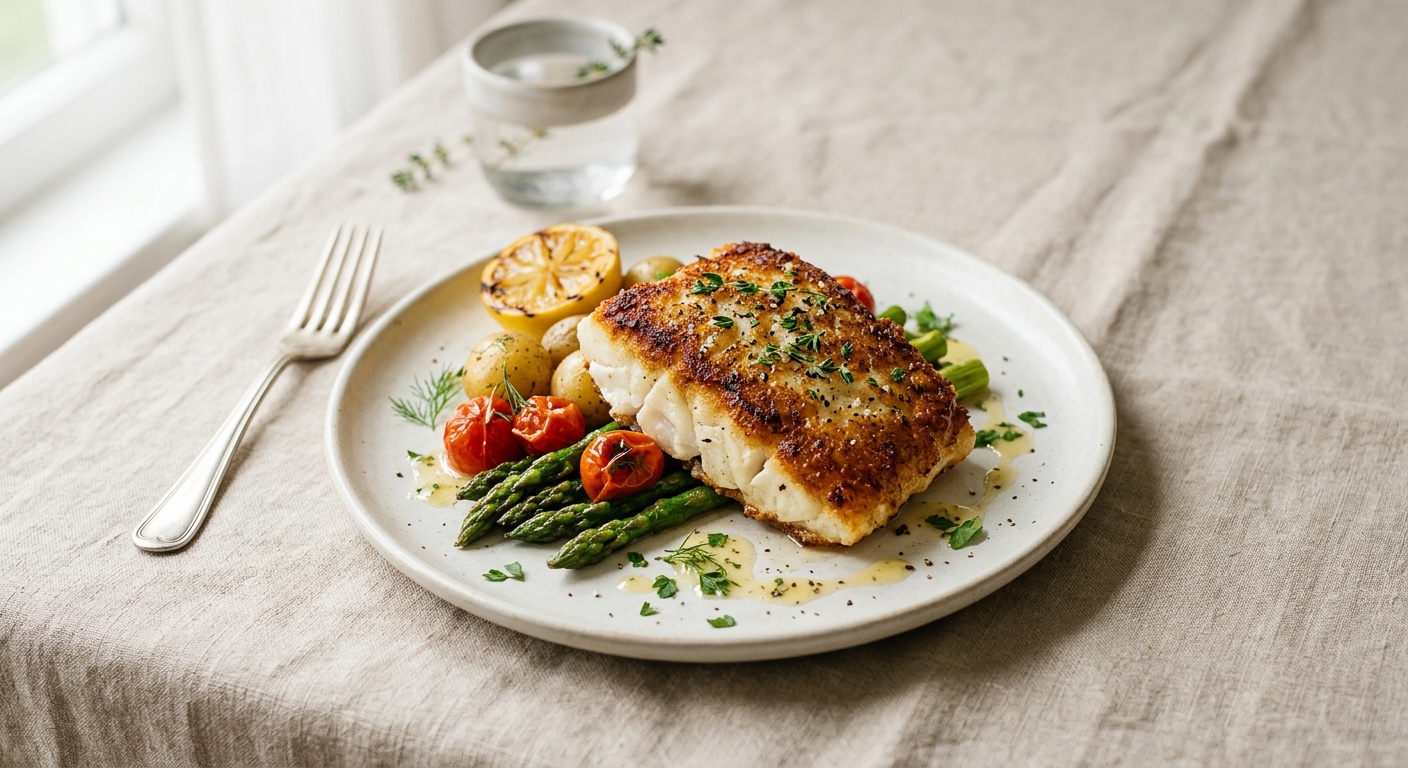
Transfer the fillets crust-side up to a plate or serving platter. Squeeze fresh lemon juice over each fillet and serve immediately.
Chef's notes
Cod is best served immediately while the crust is at its crispiest.
This technique works equally well with other thick, firm white fish fillets such as halibut, haddock, or sea bass.
For a complete meal, serve alongside roasted vegetables, a simple green salad, or mashed potatoes to soak up the lemon butter pan sauce.
Store covered in the refrigerator for up to 2 days before serving; crust will soften upon storage.